


Page 114 - DP-2-3
P. 114
Design+                                                              Building code app benefits for designers


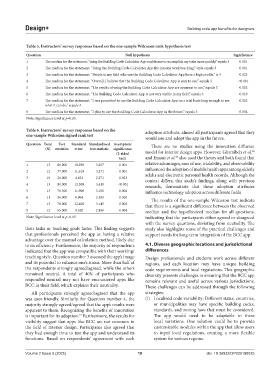
            Table 5. Instructors’ survey responses based on the one‑sample Wilcoxon rank hypothesis test
            Question                                  Null hypothesis                               Significance
            1       The median for the statement, “using the Building Code Calculator App enables me to accomplish my tasks more quickly,” equals 3  0.001
            2       The median for the statement, “Using the Building Code Calculator App fits into my work/teaching,” style equals 3  0.001
            3       The median for the statement, “People in my field who use the Building Code Calculator App have a high profile,” is 3  0.023
            4       The median for the statement, “Overall, I believe that the Building Code Calculator App is easy to use,” equals 3  <0.001
            5       The median for the statement, “The results of using the Building Code Calculator App are apparent to me,” equals 3  0.002
            6       The median for the statement, “The Building Code Calculator App is not very visible in my field,” equals 3  0.010
            7       The median for the statement, “I was permitted to use the Building Code Calculator App on a trial basis long enough to see   0.002
                    what it can do,” equals 3
            8       The median for the statement, “I plan to use the Building Code Calculator App in the future,” equals 3  0.004
            Note: Significance level at p=0.05.

            Table 6. Instructors’ survey responses based on the   adoption attribute, almost all participants agreed that they
            one‑sample Wilcoxon signed rank test
                                                               would use and adopt the app in the future.
            Question Total   Test   Standard  Standardized  Asymptotic   There are no studies using the innovation diffusion
                    (N)  statistics  error  test statistic  significance                                    18
                                                  (2‑sided     model for interior design apps. However, Gharaibeh et al.
                                                                            19
                                                    test)      and Emani et al.  also used the theory and both found that
            1        13  66.000  10.290   3.207     0.001      relative advantages, ease of use, trialability, and observability
            2        12  77.000  11.619   3.271     0.001      influenced the adoption of mobile health apps among elderly
            3        10  21.000  4.623    2.271     0.023      adults and electronic personal health records. Although the
                                                               context differs, this study’s findings, along with previous
            4        13  91.000  13.309   3.419    <0.001      research, demonstrate that these adoption attributes
            5        13  76.500  11.906   3.150     0.002      influence technology adoption across different fields.
            6        11  36.000  6.964    2.585     0.010        The results of the one-sample Wilcoxon test indicate
            7        13  78.000  12.400   3.145     0.002      that there is a significant difference between the observed
            8        12  55.000  9.520    2.889     0.004      median and the hypothesized median for all questions,
            Note: Significance level at p=0.05.                indicating that the participants either agreed or disagreed
                                                               with the survey questions, deviating from neutrality. The
            their tasks or teaching goals faster. This finding suggests   study also highlights some of the practical challenges and
            that professionals perceived the app as having a relative   support needs for long-term integration of the BCC app.
            advantage over the manual calculation method, likely due
            to its efficiency. Furthermore, the majority of respondents   4.1. Diverse geographic locations and jurisdictional
            indicated that the app was compatible with their working/  differences
            teaching style. Question number 3 assessed the app’s image   Design professionals and students work across different
            and its potential to enhance one’s status. More than half of   regions, and each location may have unique building
            the respondents strongly agreed/agreed, while the others   code requirements and local regulations. This geographic
            remained neutral. A  total of 40% of participants who   diversity presents challenges in ensuring that the BCC app
            responded neutral may not have encountered apps like   remains relevant and useful across various jurisdictions.
            BCC in their field, which explains their neutrality.  These challenges can be addressed through the following
              All participants strongly agreed/agreed that the app   strategies:
            was user-friendly. Similarly, for Question number 4, the   (i)  Localized code variability: Different states, countries,
            majority strongly agreed/agreed that the app’s results were   or municipalities may have specific building codes,
            apparent to them. Recognizing the benefits of innovation   standards, and zoning laws that must be considered.
            is important for its adoption.  Furthermore, the results for   The app would need to be adaptable to these
                                   17
            visibility suggest that apps like BCC are not common in   local variations. One solution could be to provide
            the field of interior design. Participants also agreed that   customizable modules within the app that allow users
            they had enough time to test the app and understand its   to input local regulations, creating a more flexible
            functions. Based on respondents’ agreement with each   system for various regions.


            Volume 2 Issue 3 (2025)                         18                           doi: 10.36922/DP025190025

