


Page 9 - DP-2-3
P. 9
Design+                                                             Traditional handcrafting and sustainability


            the creation of a more collective economic model, known   brands pursuing ethical transitions, while paying
            as the “we-economy,” which is based on solidarity and   limited attention to local production networks and
            cooperation among communities.  The we-economy        their potential to contribute to sustainable value
                                         30
            arises from collaborative and decentralized production,   chains
            community-based creation, and learning through practical   (iii) The majority of existing studies on traditional
            engagement and collaboration, and it fosters social capital   techniques and sustainable fashion primarily focus on
            through local and global networking. 31               individual initiatives related to the circular economy,
              The we-economy refers to non-sovereign economic     re-economy, or isolated sustainability strategies.
            relations among  participants –  including  practices  such   These approaches, although valuable, do not situate
            as communing and small-scale, bottom-up production    traditional craftsmanship within a broader, self-
            collectivities – that occur at the local level and are   managed framework encompassing economic, social,
            grounded in fair and ethical financial relationships among   and ecological dimensions.
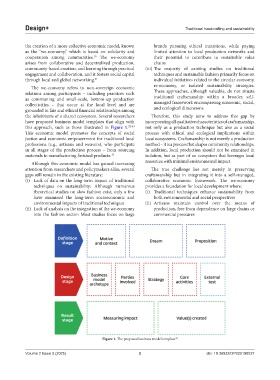
            the inhabitants of a shared ecosystem. Several researchers   Therefore,  this  study  aims  to  address  this  gap  by
            have proposed business model templates that align with   incorporating all qualitative characteristics of craftsmanship,
            this approach, such as those illustrated in  Figure  1. 32-34    not only as a production technique but also as a social
            This economic model promotes the concepts of social   process with ethical and ecological implications within
            justice and economic empowerment for traditional local   local ecosystems. Craftsmanship is not merely a production
            professions (e.g., artisans and weavers), who participate   method – it is a process that shapes community relationships.
            in all  stages of the  production process – from  sourcing   In addition, local production should not be examined in
            materials to manufacturing finished products. 35   isolation, but as part of an ecosystem that leverages local

              Although this economic model has gained increasing   resources with minimal environmental impact.
            attention from researchers and policymakers alike, several   The true challenge lies not merely in preserving
            gaps still remain in the existing literature:      craftsmanship but in integrating it into a self-managed,
            (i)  Lack of data on the long-term impact of traditional   collaborative economic framework. The we-economy
               techniques on  sustainability:  Although  numerous   provides a foundation for local development where:
               theoretical studies on slow fashion exist, only a few   (i)  Traditional techniques enhance sustainability from
               have examined the long-term socioeconomic and      both environmental and social perspectives
               environmental impacts of traditional techniques  (ii)  Artisans maintain control over the means of
            (ii)  Lack of analysis on the integration of the we-economy   production, free from dependence on large chains or
               into the fashion sector: Most studies focus on large   commercial pressures


                                             Figure 1. The proposed business model template 34


            Volume 2 Issue 3 (2025)                         3                            doi: 10.36922/DP025190027

