


Page 13 - DP-2-3
P. 13
Design+                                                             Traditional handcrafting and sustainability


               formation of small cooperative networks that support   of these thematic categories from the literature, with an
               the production of high-quality products on a limited   emphasis on mapping sustainable practices across all stages
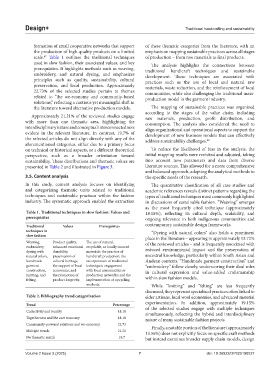
               scale.   Table  1 outlines the traditional techniques   of production – from raw materials to final products.
                    47
               used in slow fashion, their associated values, and key   The analysis highlights the connections between
               prerequisites. It highlights methods such as weaving,   traditional handicraft  techniques  and  sustainable
               embroidery, and natural dyeing, and emphasizes   development.  These  techniques  are  associated  with
               principles such as quality, sustainability, cultural   practices such as the use of local and natural raw
               preservation, and  local  production.  Approximately   materials, waste reduction, and the reinforcement of local
               22.73%  of  the  selected  studies  pertain  to  themes   communities, while also challenging the traditional mass-
               related to “the we-economy and community-based   production model in the garment industry.
               solutions,” reflecting a cautious yet meaningful shift in
               the literature toward alternative production models.  The mapping of sustainable practices was organized
                                                               according to the stages of the value chain, including
              Approximately 21.21% of the reviewed studies engage   raw materials, production, profit distribution, and
            with  more  than  one  thematic  area,  highlighting  the   consumption. The analysis also considered the  need to
            interdisciplinary nature and conceptual interconnectedness   align organizational and operational aspects to support the
            evident in the relevant literature. In contrast, 19.7% of   development of new business models that can effectively
            the selected articles do not align directly with any of the   address sustainability challenges. 48
            aforementioned categories, either due to a primary focus
            on technical or historical aspects, or a different theoretical   To reduce the likelihood of bias in the analysis, the
            perspective,  such  as a  broader  orientation toward   initial mapping results were revisited and adjusted, taking
            sustainability. These distributions and thematic values are   into account new parameters and data from diverse
            presented in Table 2 and illustrated in Figure 3.  literature sources. This allowed for a more comprehensive
                                                               and balanced approach, adapting the analytical methods to
            3.5. Content analysis                              the specific needs of the research.
            In this study, content analysis focuses on identifying   The quantitative classification of all case studies and
            and categorizing thematic units related to traditional   academic references reveals distinct patterns regarding the
            techniques and sustainable practices within the fashion   types of traditional techniques most commonly highlighted
            industry. The systematic approach enabled the extraction   in discussions of sustainable fashion. “Weaving” emerges
                                                               as the most frequently cited technique (approximately
            Table 1. Traditional techniques in slow fashion: Values and   18.18%), reflecting its cultural depth, scalability, and
            prerequisites                                      ongoing relevance in both indigenous communities and
            Traditional     Values         Prerequisites       contemporary sustainable design frameworks.
            techniques in                                        “Dyeing with natural colors” also holds a prominent
            slow fashion                                       place in the literature – appearing in approximately 13.72%
            Weaving,   Product quality,   The use of natural,   of the reviewed articles – and is frequently associated with
            embroidery,   enhanced emotional  recyclable, or locally sourced
            dyeing with   durability,   materials; the practice of   reduced environmental impact and the preservation of
            natural colors,   preservation of   handicraft production; the   ancestral knowledge, particularly within South Asian and
            handmade   cultural heritage,   incorporation of traditional   Andean contexts. “Handmade garment construction” and
            garment    the support of local  techniques; engagement   “embroidery” follow closely, underscoring their dual roles
            construction,   economies, and   with local communities or   in cultural expression and value-added craftsmanship
            knitting, and   the promotion of   production networks; and the
            felting.   product longevity.  implementation of upcycling   within slow fashion models.
                                      methods.                   While “knitting” and “felting” are less frequently
                                                               discussed, they represent specialized practices often linked to
            Table 2. Bibliography trend categorization         elder artisans, local wool economies, and advanced material
            Trend                                Percentage    experimentation. In addition, approximately 19.15%
            Collectivity and locality              18.18       of the selected studies engage with multiple techniques
                                                               simultaneously, reflecting the hybrid and interdisciplinary
            Togetherness and the care economy      18.18       nature of many sustainable fashion projects.
            Community-powered solutions and we-economy  22.73    Finally, a notable portion of the literature (approximately
            Multiple trends                        21.21       13.56%) does not explicitly focus on specific craft methods
            No thematic match                       19.7       but instead examines broader supply chain models, design


            Volume 2 Issue 3 (2025)                         7                            doi: 10.36922/DP025190027

