


Page 18 - DP-2-3
P. 18
Design+                                                             Traditional handcrafting and sustainability


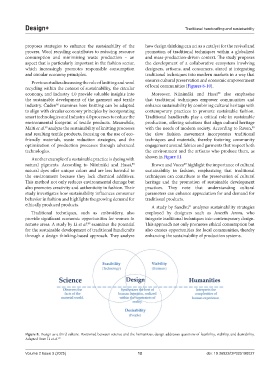
            proposes strategies to enhance the sustainability of the   how design thinking can act as a catalyst for the revival and
            process. Wool recycling contributes to reducing resource   promotion of traditional techniques within a globalized
            consumption and minimizing waste production – an   and mass-production-driven context. The study proposes
            aspect that is particularly important in the fashion sector,   the development of a collaborative ecosystem involving
            which increasingly promotes responsible consumption   designers, artisans, and  consumers,  aimed at  integrating
            and circular economy principles.                   traditional techniques into modern markets in a way that
              Previous studies discussing the role of knitting and wool   ensures cultural preservation and economic empowerment
            recycling within the context of sustainability, the circular   of local communities (Figures 8-10).
            economy, and Industry 4.0 provide valuable insights into   Moreover, Niinimäki and Hassi  also emphasize
                                                                                              88
            the  sustainable  development  of  the  garment  and  textile   that traditional techniques empower communities and
            industry. Čuden examines how knitting can be adapted   enhance sustainability by combining cultural heritage with
                         86
            to align with circular economy principles by incorporating   contemporary practices to promote sustainable fashion.
            smart technologies and Industry 4.0 processes to reduce the   Traditional  handicrafts  play  a  critical  role  in  sustainable
            environmental  footprint  of  textile  products.  Meanwhile,   production, offering solutions that align cultural heritage
            Maiti et al. analyze the sustainability of knitting processes   with the needs of modern society. According to Raven,
                                                                                                            90
                    87
            and resulting textile products, focusing on the use of eco-  the slow fashion movement incorporates traditional
            friendly materials, waste reduction strategies, and the   techniques and materials, thereby fostering community
            optimization  of  production  processes  through  advanced   engagement around fabrics and garments that respect both
            technologies.                                      the environment and the artisans who produce them, as
              Another example of a sustainable practice is dyeing with   shown in Figure 11.
            natural pigments. According to Niinimäki and Hassi,    Brown and Vacca  highlight the importance of cultural
                                                                               49
                                                         88
            natural dyes offer unique colors and are less harmful to   sustainability  in  fashion,  emphasizing  that  traditional
            the environment because they lack chemical additives.   techniques can contribute to the preservation of cultural
            This method not only reduces environmental damage but   heritage and  the  promotion  of sustainable  development
            also promotes creativity and authenticity in fashion. Their   practices. They note that understanding cultural
            study investigates how sustainability influences consumer   parameters can enhance appreciation for and demand for
            behavior in fashion and highlights the growing demand for   traditional products.
            ethically produced products.                         A study by Sandhu  analyzes sustainability strategies
                                                                                 91
              Traditional techniques, such as embroidery, also   employed by designers such as Aneeth Arora, who
            provide significant economic opportunities for women in   integrate traditional techniques into contemporary design.
            remote areas. A study by Li et al.  examines the potential   This approach not only promotes ethical consumption but
                                      89
            for the sustainable development of traditional handicrafts   also creates opportunities for local communities, thereby
            through a design thinking-based approach. They analyze   enhancing the sustainability of production systems.


            Figure 8. Design as a third culture: Positioned between science and the humanities, design addresses questions of feasibility, viability, and desirability.
            Adapted from Li et al. 89


            Volume 2 Issue 3 (2025)                         12                           doi: 10.36922/DP025190027

