


Page 15 - DP-2-3
P. 15
Design+                                                             Traditional handcrafting and sustainability


               related to traditional textile techniques and their role   4.1. Sustainability and ethics in fashion
               in sustainable fashion systems and the we-economy  The connection between traditional handicrafts and
            (ii)  The analysis is restricted to English-language sources   sustainable, ethical fashion has been highlighted in
               published between 2000 and 2024, potentially    numerous studies as an effective approach to achieving
               excluding relevant regional publications and non-  a more responsible and socially equitable production
               academic perspectives
            (iii) While a wide range of case examples is reviewed, the   model. Traditional techniques – which often involve the
                                                               use of local, natural materials and handmade production
               study does not include original fieldwork or empirical   – offer alternative solutions to the dominant industrialized
               data and, as such, cannot offer generalized conclusions   production system, promoting the concept of slow fashion.
               beyond the scope of the reviewed literature.
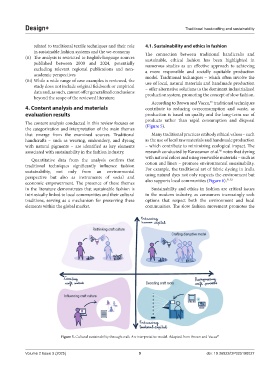
                                                                 According to Brown and Vacca,  traditional techniques
                                                                                          49
            4. Content analysis and materials                  contribute to reducing overconsumption and waste, as
            evaluation results                                 production is based on quality and the long-term use of
                                                               products rather than rapid consumption and disposal
            The content analysis conducted in this review focuses on   (Figure 5).
            the categorization and interpretation of the main themes
            that emerge  from the  examined sources.  Traditional   Many traditional practices embody ethical values – such
            handicrafts – such as weaving, embroidery, and dyeing   as the use of local raw materials and handmade production
            with natural pigments – are identified as key elements   – which contribute to minimizing ecological impact. The
            associated with sustainability in the fashion industry.  research conducted by Karaosman et al.  notes that dyeing
                                                                                              50
              Quantitative data from the analysis confirm that   with natural colors and using renewable materials – such as
            traditional techniques significantly influence fashion   cotton and linen – promote environmental sustainability.
                                                               For example, the traditional art of fabric dyeing in India
            sustainability,  not  only  from  an  environmental
            perspective but also as instruments of social and   using natural dyes not only respects the environment but
                                                                                                 51,52
            economic empowerment. The presence of these themes   also supports local communities (Figure 6).
            in the literature demonstrates that sustainable fashion is   Sustainability and ethics in fashion are critical issues
            intrinsically linked to local communities and their cultural   in the modern industry, as consumers increasingly seek
            traditions, serving as a mechanism for preserving these   options that respect both the environment and local
            elements within the global market.                 communities. The slow fashion movement promotes the


                           Figure 5. Cultural sustainability through craft: An interpretative model. Adapted from Brown and Vacca 49


            Volume 2 Issue 3 (2025)                         9                            doi: 10.36922/DP025190027

