


Page 11 - DP-2-3
P. 11
Design+                                                             Traditional handcrafting and sustainability


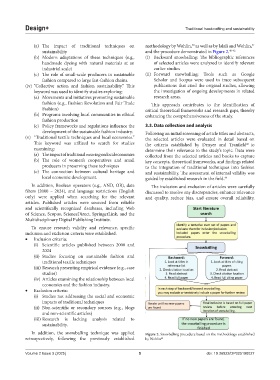
               (a)  The impact of traditional techniques on    methodology by Wohlin,  as well as by Jalali and Wohlin,
                                                                                   40
                                                                                                            41
                   sustainability                              and the procedure demonstrated in Figure 2. 40-42
               (b)  Modern adaptations of these techniques (e.g.,   (i)  Backward snowballing: The bibliographic references
                   handmade dyeing with natural materials at an   of selected articles were analyzed to identify relevant
                   industrial scale)                              earlier studies
               (c)  The role of small-scale producers in sustainable   (ii)  Forward snowballing: Tools such as Google
                   fashion compared to large fast-fashion chains.  Scholar and Scopus were used to trace subsequent
            (iv)  “Collective action and fashion sustainability.” This   publications that cited the original studies, allowing
               keyword was used to identify studies exploring:    the investigation of ongoing developments in related
               (a)  Movements and initiatives promoting sustainable   research areas.
                   fashion (e.g., Fashion Revolution and Fair Trade   This approach contributes to the identification of
                   Fashion)                                    critical theoretical frameworks and research gaps, thereby
               (b)  Programs involving local communities in ethical   enhancing the comprehensiveness of the study.
                   fashion production
               (c)  Policy frameworks and regulations influence the   3.3. Data collection and analysis
                   development of the sustainable fashion industry.  Following an initial screening of article titles and abstracts,
            (v)  “Traditional textile techniques and local economies.”   the selected articles were evaluated in detail based on
               This  keyword  was  utilized  to  search  for  studies   the criteria established by Denyer and Tranfield to
                                                                                                          43
               examining:                                      determine their relevance to the study’s topic. Data were
               (a)  The impact of traditional weaving on local economies  collected from the selected articles and books to capture
               (b)  The role of women’s cooperatives and small   key concepts, theoretical frameworks, and findings related
                   producers in preserving these techniques    to the integration of traditional techniques into fashion
               (c)  The connection between cultural heritage and   and sustainability. The assessment of internal validity was
                   local economic development.                 guided by established research in the field. 44
              In addition, Boolean operators (e.g., AND, OR), date   The inclusion and exclusion of articles were carefully
            filters (2000 – 2024), and language restrictions (English   discussed to resolve any discrepancies, enhance relevance
            only) were applied when searching for the relevant   and quality, reduce bias, and ensure overall reliability.
            articles. Published articles were sourced from reliable
            and scientifically recognized databases, including Web
            of Science, Scopus, ScienceDirect, SpringerLink, and the
            Multidisciplinary Digital Publishing Institute.
              To ensure research validity and relevance, specific
            inclusion and exclusion criteria were established.
            •   Inclusion criteria:
               (i)  Scientific articles published between 2000 and
                   2024
               (ii)  Studies focusing on sustainable fashion and
                   traditional textile techniques
               (iii) Research presenting empirical evidence (e.g., case
                   studies)
               (iv)  Articles examining the relationship between local
                   economies and the fashion industry.
            •   Exclusion criteria:
               (i)  Studies not addressing the social and economic
                   impacts of traditional techniques
               (ii)  Non-scientific or secondary sources (e.g., blogs
                   and non-scientific articles)
               (iii) Research is lacking analysis related to
                   sustainability.
              In  addition,  the snowballing  technique was  applied   Figure 2. Snowballing procedure based on the methodology established
            retrospectively,  following the previously  established   by Wohlin 40


            Volume 2 Issue 3 (2025)                         5                            doi: 10.36922/DP025190027

