


Page 110 - EER-1-1
P. 110
Explora: Environment
            and Resource                                                         Stratification and mixed layer deepening


              Hence, the sequence (θ ) is strictly increasing.
                                 t
                                 n
              Similarly, from line 4 of Table S2, we have:
                    t
              t t   = t  +T /C’                       (XII)
               n+1  n   n  dyn
              where T  represents the necessarily positive energy
                     n
            balance entering the atmosphere and leaving it through the
            UOS or the top of the troposphere. Consequently:
              t t n+1 >t t n                          (XIII)
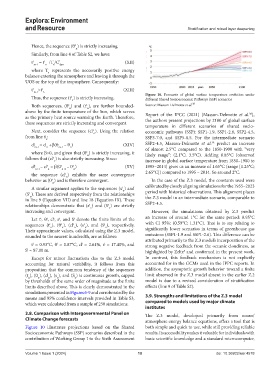
              Thus, the sequence (t ) is strictly increasing.  Figure  10.  Forecasts of global surface temperature evolution under
                               t
                                n                              different Shared Socioeconomic Pathways (SSP) scenarios
              Both sequences, (θ ) and (t ), are further bounded-  Source: Masson-Delmotte et al. 38
                                      t
                              t
                              n
                                      n
            above by the finite temperature of the Sun, which serves                                       38
            as the primary heat source warming the Earth. Therefore,   Report of the IPCC (2021) (Masson-Delmotte  et al. ),
            these sequences are strictly increasing and convergent.  the authors present projections by 2100 of global surface
                                                               temperature in different scenarios of shared socio-
              Next, consider the sequence (cl ). Using the relation   economic pathways (SSP): SSP1-1.9, SSP1-2.6, SSP2-4.5,
                                        t
                                         n
            from line 6 :                                      SSP3-7.0,  and SSP5-8.5.  For the  intermediate  scenario
                     a
                                                                                           38
              cl  = cl  +β(θ  – θ )                  (XIV)     SSP2-4.5,  Masson-Delmotte  et al.   predict  an  increase
                n+1   n   n+1  n                               of  almost  2.5°C  compared  to  the 1850-1900  with “very
              where β>0, and given that (θ ) is strictly increasing, it   likely range”: (2.1°C; 3.5°C). Adding 0.85°C (observed
                                      t
                                      n
            follows that (cl ) is also strictly increasing. Since:
                        t
                        n                                      increase in global surface temperature from 1850–1900 to
              cl t  – cl  = β(θ t  – θ )              (XV)     1995–2014) gives us an increase of 1.65°C (range [1.25°C;
                     t
                                t
                n+1   n    n+1   n
              the sequence (cl ) exhibits the same convergence   2.65°C]) compared to 1995 – 2014. So around 2°C.
                             t
                             n
            behavior as (θ ) and is therefore convergent.        In the case of the Z.3 model, the constants used were
                       t
                       n
              A similar argument applies to the sequences (s ) and   calibrated by closely aligning simulations for the 1955–2023
                                                     t
                                                     n
            (S ). These are derived respectively from the relationships   period with historical observations. This alignment places
             t
              n
            in line 9 (Equation VII) and line 18 (Equation IX). These   the Z.3 model in an intermediate scenario, comparable to
            relationships demonstrate that (s ) and (S ) are strictly   SSP2-4.5.
                                               t
                                       t
                                               n
                                       n
            increasing and convergent.                           However, the simulations obtained by Z.3 predict
              Let t ,  θ , cl , s , and S  denote the finite limits of the   an increase of around 1°C  for the  same period: 0.95°C
                                t
                          t
                        t
                     t
                  t
                                             t
                           t
                                t
                                     t
            sequences (t ), (θ ), (cl ), (s ), and (S ), respectively.   with CI 95%: (0.59°C; 1.31°C). That is to say relating to
                      t
                                              n
                                n
                      n
                           n
                                     n
            Their approximate values, calculated using the Z.3 model,   significantly lower scenarios in terms of greenhouse gas
            rounded to the nearest hundredth, are as follows:  emissions (SSP1-1.9 and SSP1-2.6). This difference can be
                                                               attributed primarily to the Z.3 model’s incorporation of the
              t  ≈ 0.93°C, θ  ≈ 0.87°C, cl  ≈ 2.61%, s  ≈ 17.40%, and   strong negative feedback from the oceanic cloudiness, as
               t
                                    t
                         t
                                             t
            S  ≈ 87.00 m.                                      highlighted by Zeltz  and confirmed in the present work.
             t
                                                                               8
              Except for minor fluctuations due to the Z.3 model   In contrast, this  feedback mechanism is not explicitly
            accounting for natural variability, it follows from this   accounted for in the GCMs used in the IPPC reports. In
            proposition  that  the  common  tendency  of  the  sequences   addition, the asymptotic growth behavior toward a finite
            (t ), (θ ), (cl ), (s ), and (S ) is continuous growth, capped   limit observed in the Z.3 model absent in the earlier Z.2
             n
                         n
                 n
                     n
                                 n
            by thresholds of the same order of magnitude as the finite   model is due to a revised consideration of stratification
            limits described above. This is clearly demonstrated in the   effects (line 9 of Table S2).
            simulations presented in Figures 6-9 and corroborated by the
            means and 95% confidence intervals provided in Table S3,   3.9. Strengths and limitations of the Z.3 model
            which were calculated from a sample of 250 simulations.  compared to models used by major climate
                                                               institutes
            3.8. Comparison with Intergovernmental Panel on    The Z.3 model, developed primarily from ocean/
            Climate Change forecasts                           atmosphere energy balance equations, offers a tool that is
            Figure  10  illustrates  projections  based on  the  Shared   both simple and quick to use, while still providing reliable
            Socioeconomic Pathways (SSP) scenarios described in the   results. Its accessibility makes it valuable for individuals with
            contribution of Working Group I to the Sixth Assessment   basic scientific knowledge and a standard microcomputer,
            Volume 1 Issue 1 (2024)                         10                               doi: 10.36922/eer.4578

