


Page 105 - EER-1-1
P. 105
Explora: Environment
            and Resource                                                         Stratification and mixed layer deepening


            3.2.2. Influence of the intertropical convergence zone   3.2.3. Role of the El Niño-Southern Oscillation
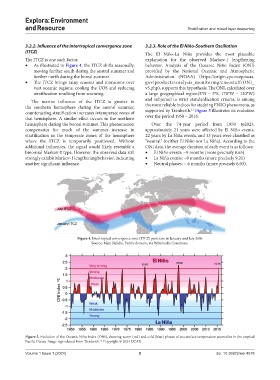
            (ITCZ)                                             The  El  Niño-La  Niña  provides  the  most  plausible
            The ITCZ is one such factor.                       explanation for the observed Markov-1 lengthening
            •   As illustrated in Figure 4, the ITCZ shifts seasonally,   behavior. Analysis of the Oceanic Niño Index (ONI)
               moving further south during the austral summer and   provided by the National Oceanic and Atmospheric
               further north during the boreal summer.         Administration (NOAA) (https://origin.cpc.ncep.noaa.
            •   The  ITCZ  brings  rainy  seasons  and  monsoons  over   gov/products/analysis_monitoring/ensostuff/ONI_
               vast oceanic regions, cooling the UOS and reducing   v5.php), supports this hypothesis. The ONI, calculated over
               stratification resulting from warming.          a large geographical region(5°N – 5°S, 170°W – 120°W)
              The marine influence of the ITCZ is greater in   and subjected to strict standardization criteria, is among
            the southern hemisphere during the austral summer,   the most reliable indices for studying ENSO phenomena, as
                                                                                  13
            counteracting stratification increases intemperate zones of   supported by Trenberth.  Figure 5 illustrates its evolution
            that hemisphere. A similar effect occurs in the northern   over the period 1950 – 2016.
            hemisphere during the boreal summer. This phenomenon   Over the 74-year period from 1950 to2023,
            compensates for much of the summer increase in     approximately 21 years were affected by El Niño events,
            stratification in the temperate zones of the hemisphere   22 years by La Niña events, and 33 years were classified as
            where the ITCZ is temporarily positioned. Without   “neutral” (neither El Niño nor La Niña). According to the
            additional influences, the signal would likely resemble a   ONI data, the average duration of each event is as follows:
            binomial Markov-0 type. However, the observed data still   •   El Niño events: ~9 months (more precisely 8.65)
            strongly exhibit Markov-1 lengthening behavior, indicating   •   La Niña events: ~9 months (more precisely 9.21)
            another significant influence.                     •   Neutral phases: ~ 6 months (more precisely 6.03).


                                  Figure 4. Intertropical convergence zone (ITCZ) positions in January and July 2006
                                        Source: Mats Halldin, Public domain, via Wikimedia Commons.


            Figure 5. Evolution of the Oceanic Niño Index (ONI), showing warm (red) and cold (blue) phases of sea surface temperature anomalies in the tropical
            Pacific Ocean. Image reproduced from Trenberth.  Copyright © 2024 UCAR
                                            13
            Volume 1 Issue 1 (2024)                         5                                doi: 10.36922/eer.4578

