


Page 102 - EER-1-1
P. 102
Explora: Environment
            and Resource                                                         Stratification and mixed layer deepening


            (iii) Disruption of precipitation and river runoff: Climate   these results prove accurate, they could significantly
               change has altered precipitation patterns and increased   alter the guidance provided to policymakers on
               river discharge, leading to the formation of a less   addressing climate change.
               salty surface layer. This layer becomes more isolated
               from deeper waters, with salinity changes playing an   2. Materials and methods
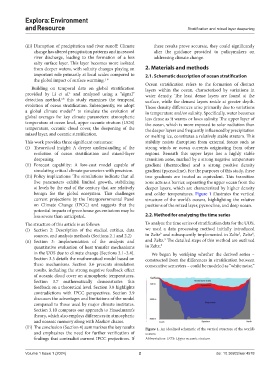
               important role primarily at local scales compared to   2.1. Schematic description of ocean stratification
               the global impact of surface warming. 1-6
                                                               Ocean stratification refers to the formation of distinct
              Building on temporal data on global stratification   layers within the ocean, characterized by variations in
            provided by Li  et  al.  and analyzed using a “signal”   water density. The least dense layers are found at the
                              1
            detection method,  this study examines the temporal   surface, while the densest layers reside at greater depth.
                           7,8
            evolution of ocean stratification. Subsequently, we adopt   These density differences arise primarily due to variations
            a global climate model  to simulate the evolution of   in temperature and/or salinity. Specifically, water becomes
                                7,8
            global averages for key climate parameters: atmospheric   less dense as it warms or loses salinity. The upper layer of
            temperature at ocean level, upper oceanic stratum (UOS)   the ocean, which is more exposed to solar radiation than
            temperature, oceanic cloud cover, the deepening of the   the deeper layers and frequently influenced by precipitation
            mixed layer, and oceanic stratification.           or melting ice, constitutes a relatively stable stratum. This
            This work provides three significant outcomes:     stability resists disruption from external forces such as
            (i)  Theoretical insight: A  deeper understanding of the   strong winds or ocean currents originating from other
               evolution  of  ocean  stratification  and  mixed-layer   regions. Beneath this upper layer lies a highly stable
               deepening.                                      transition zone, marked by a strong negative temperature
            (ii)  Forecast  capability: A  low-cost  model  capable  of   gradient (thermocline) and a strong positive density
               simulating critical climate parameters with precision.  gradient (pycnocline). For the purposes of this study, these
            (iii) Policy implications: The simulations indicate that all   two gradients are treated as equivalent. This transition
               five parameters exhibit limited growth, stabilizing   zone acts as a barrier, separating the upper ocean from the
               at levels by the end of the century that are relatively   deeper layers, which are characterized by higher density
               benign for the global ecosystem. This challenges   and colder temperatures. Figure 1 illustrates the vertical
               current projections by the Intergovernmental Panel   structure of the world’s oceans, highlighting the relative
               on Climate Change  (IPCC) and suggests that the   positions of the mixed layer, pycnocline, and deep ocean.
               potential impacts of greenhouse gas emissions may be
               less severe than anticipated.                   2.2. Method for analyzing the time series
            The structure of this article is as follows:       To analyze the time series of stratification data for the UOS,
            (i)  Section  2:  Description  of  the  studied  entities,  data   we used a data processing method initially introduced
                                                                     9
                                                                                                            8
                                                                                                       7
               sources, and analysis methods (Sections 2.1 and 2.2)  in Zeltz  and subsequently implemented in Zeltz , Zeltz ,
                                                                       9
            (ii)  Section 3: Implementation of the analysis and   and Zeltz.  The detailed steps of this method are outlined
               quantitative evaluation of heat transfer mechanisms   in Zeltz. 8
               in the UOS due to climate change (Sections 3.1–3.4).   We began by verifying whether the derived series –
               Section 3.5 details the mathematical model based on   constructed from the differences in stratification between
               these  mechanisms.  Section  3.6  presents  simulation   consecutive semesters – could be modeled as “white noise,”
               results, including the strong negative feedback effect
               of oceanic cloud cover on atmospheric temperatures.
               Section 3.7 mathematically demonstrates this
               feedback on a theoretical level. Section 3.8 highlights
               contradictions with IPCC perspectives. Section 3.9
               discusses the advantages and limitations of the model
               compared to those used by major climate institutes.
               Section 3.10 compares our approach to Hasselmann’s
               theory, which also employs differences in atmospheric
               and oceanic memory along with Markov chains.
            (iii) The conclusion (Section 4) summarizes the key results   Figure 1. An idealized schematic of the vertical structure of the world’s
               and emphasizes the need for further verification of   oceans
               findings that contradict current IPCC projections. If   Abbreviation: UOS: Upper oceanic stratum.


            Volume 1 Issue 1 (2024)                         2                                doi: 10.36922/eer.4578

