


Page 97 - EER-1-1
P. 97
Explora: Environment
            and Resource                               Accelerated carbonation for heavy metal inhibition in incineration bottom ash


            Table 4. Leaching results of native and carbonated IBA (in µg/kg of metal/IBA) as well as NEA limit value for determining
            application as construction materials
            Heavy metal   NEA limit value  Native IBA   IBA‑AC2     IBA‑AC4    IBA‑AC6    IBA‑AC8    IBA‑AC10
            Cd                 1              9.2          7.3         3.6        3.1       3.1         2.8
            Cr                 40            701.8        797.2       559.2      456.9      464.9      384.8
            Cu                 60            2519.6       630.0       385.8      353.5      317.7      275.3
            Ni                 10             338         128.9        87.4      80.2        88         91.6
            Pb                 20             2.4          0.9         1.2        1.0       0.7         2.1
            Zn                200            83.1         45.3         38.5      43.1       34.4        32.3
            Abbreviations: AC: Ammonium carbonate; IBA: Incineration bottom ash; NEA: The National Environment Agency of Singapore.

                         A                                  B


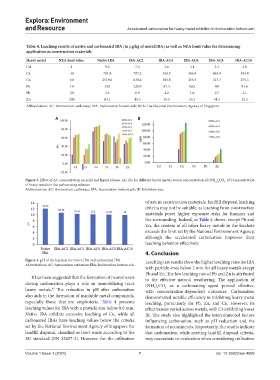
            Figure 3. Effect of AC concentration on solid and liquid phases. (A) IRs for different heavy metals versus concentration of (NH ) CO . (B) Concentration
                                                                                                3
                                                                                             4 2
            of heavy metals in the carbonating solution
            Abbreviations: AC: Ammonium carbonate; IBA: Incineration bottom ash; IR: Inhibition rate.
                                                               of ash in construction materials, landfill disposal leaching
                                                               criteria may not be suitable, as leaching from construction
                                                               materials poses higher  exposure risks for humans and
                                                               the surrounding. Indeed, as Table 4 shows, except Pb and
                                                               Zn, the content of all other heavy metals in the leachate
                                                               exceeds the limit set by the National Environment Agency,
                                                               although the accelerated carbonation improves their
                                                               leaching behavior effectively.
                                                               4. Conclusion
            Figure 4. pH of the leachate for native IBA and carbonated IBA  Leaching test results show the higher leaching rates for IBA
            Abbreviations: AC: Ammonium carbonate; IBA: Incineration bottom ash.
                                                               with particle sizes below 2 mm for all heavy metals except
                                                               Pb and Zn. The low leaching rate of Pb and Zn is attributed
              It has been suggested that the formation of neominerals   to the effective natural weathering. The application of
            during carbonation plays a role in immobilizing trace   (NH ) CO  as a carbonating agent proved effective,
                                                                       3
                                                                   4 2
            heavy metals.  The reduction in pH after carbonation   with concentration-dependent outcomes. Carbonation
                       45
            also aids in the formation of insoluble metal compounds,   demonstrated notable efficiency in inhibiting heavy metal
            especially those that are amphoteric.  Table 4 presents   leaching, particularly for Pb, Zn, and Cu. However, its
            leaching values for IBA with a particle size below 0.6 mm.   effectiveness varied across metals, with Cr exhibiting lower
            Native IBA exhibits excessive leaching of Cu, while all   IR. The study also highlighted the interconnected factors
            carbonated IBAs have leaching values below the criteria   influencing carbonation, such as pH reduction and the
            set by the National Environment Agency of Singapore for   formation of neominerals. Importantly, the results indicate
            landfill disposal, classified as inert waste according to the   that carbonation, while meeting landfill disposal criteria,
            EU standard (EN 12457-2). However, for the utilization   may necessitate re-evaluation when considering utilization


            Volume 1 Issue 1 (2024)                         7                                doi: 10.36922/eer.4609

