


Page 96 - EER-1-1
P. 96
Explora: Environment
            and Resource                               Accelerated carbonation for heavy metal inhibition in incineration bottom ash


            solution efficiently reacts with the alkaline components in   2 wt%. The inhibitory effect diminishes when (NH ) CO
                                                                                                        4 2
                                                                                                             3
            IBA, facilitating the accelerated carbonation process.  concentration exceeds 4%, aligning with the observed
                                                               trend in carbonation efficiency (Figure 1B). In contrast,
            3.3. Leaching behavior of native IBA               carbonation demonstrates lower efficacy in reducing
            Cd, Cr, Cu, Ni, Pb, and Zn are selected as metals of concern   the leaching of Cr, achieving only a 45% IR even with a
            due to their high leaching rate, potential hazards, and risks   higher (NH ) CO  concentration of 10 wt%. The leaching
                                                                             3
                                                                        4 2
            to human health and the environment if they leach into   situation worsens when the (NH ) CO  concentration
                                                                                                3
                                                                                            4 2
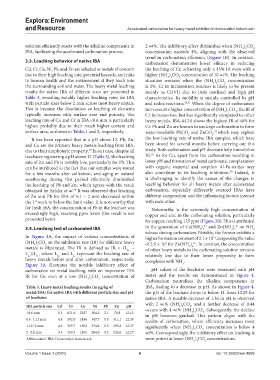
            the surrounding soil and water. The heavy metal leaching   is 2%. Cr in incineration residues is likely to be present
            results for native IBA of different sizes are presented in   mainly  as Cr(VI) due to their oxidized  and  high  pH
            Table 3, revealing notably higher leaching rates for IBA   characteristics. Its mobility is mainly controlled by pH
            with particle sizes below 2 mm across most heavy metals.   and redox reactions. 50,51  When the degree of carbonation
            This is because the dissolution or leaching of elements   increases at a higher concentration of (NH ) CO , the IR of
                                                                                                     3
                                                                                                4 2
            typically increases with surface area and porosity. The   Cr increases too, but less significantly compared to other
            leaching rate of Cu and Cr in IBA <0.6 mm is particularly   heavy metals. IBA-AC10 shows the highest IR of 46% for
            higher, probably due to their much higher content and   Cr. Pb and Zn are known to undergo carbonation to form
            surface area, as shown in Tables 1 and 2, respectively.  water-insoluble PbCO  and ZnCO , which may explain
                                                                                            51
                                                                                 3

                                                                                           3
              It has been reported that at a pH above 12, Pb, Zn,   the low leaching rate of native IBA samples, which have
            and Cu are the primary heavy metals leaching from IBA,   been stored for several months before carrying out this
            due to their amphoteric property.  In our case, despite all   study. Both carbonation and pH decrease help immobilize
                                       49
                                                                 52
            leachates registering a pH above 12 (Table 3), the leaching   Ni.  As for Cu, apart from the carbonation resulting in
            rate of Zn and Pb is notably low, particularly for Pb. This   lower pH and formation of metal carbonate, complexation
            can be attributed to the fact that our samples were stored   with organic material and sorption Al-Fe-oxides may
                                                                                                   30
            for a few months after collection, and aging or natural   also contribute to its leaching inhibition.  Indeed, it
            weathering during this period effectively diminished   is challenging to identify the causes of the changes in
            the leaching of Pb and Zn, which agrees with the result   leaching behavior for all heavy metals after accelerated
            obtained by Arickx et al.  It was observed that leaching   carbonation, especially differently sourced IBAs have
                                30
            of Zn and Pb for IBA of 0.1 – 2 mm decreased within   different composition and the influencing factors interact
                st
            the 1  week to below the limit value. It is noteworthy that   with each other.
            for fresh IBA, the concentration of Pb in the leachate was   Noteworthy is the extremely high concentration of
            exceedingly high, reaching ppm levels (the result is not   copper and zinc in the carbonating solution, particularly
            presented here).                                   for copper, reaching 125 ppm (Figure 3B). This is attributed
                                                                                        2+
            3.4. Leaching test of carbonated IBA               to the generation of Cu(NH )  and Zn(NH )  2+  on NH
                                                                                                             3
                                                                                      3 4
                                                                                                   3 4
                                                               release during carbonation. Notably, the former exhibits a
            In  Figure  3A, the impact of various concentrations of   higher formation constant of 2.1 × 10 , surpassing the value
                                                                                            13
            (NH ) CO  on the inhibition rate (IR) for different heavy   of 2.9 × 10  for Zn(NH ) . In contrast, the concentration
                                                                       9
                                                                                   2+
                    3
                4 2
            metals is illustrated. The IR is defined as IR = (L  −   of other heavy metals in the carbonating solution remains
                                                                                 3 4
                                                       bc
            L )/L , where L  and L  represent the leaching rate of   relatively low due to their lower propensity to form
             ac
                bc
                                ac
                         bc
            heavy  metals  before  and after  carbonation, respectively.   complexes with NH .
            Figure  3A illustrates the notable inhibitory effect of            3
            carbonation on metal leaching, with an impressive 75%   pH values of the leachates were measured with pH
            IR for Cu even at a low (NH ) CO  concentration of   meter  and  the results  are  demonstrated  in  Figure  4.
                                      4 2  3
                                                               Carbonation neutralizes the alkaline components in
            Table 3. Heavy metal leaching results (in µg/kg of    IBA, leading to a decrease in pH. As shown in Figure 4,
            metal/IBA) for native IBA with different particle size and pH   the pH of the leachate drops to below 11 from 12.25 for
            of leachates                                       native IBA. A notable decrease of 1.36 in pH is observed
                                                               with 2 wt% (NH ) CO , and a further decrease of 0.44
            IBA particle size  Cd  Cr  Cu  Ni  Pb  Zn  pH                    4 2  3
            <0.6 mm       8.3  631.6  2267  304.2  2.1  74.8  12.12  occurs with 4 wt% (NH ) CO . Subsequently, the decline
                                                                                       3
                                                                                  4 2
                                                               in pH becomes gradual. This pattern aligns with the
            0.6−1.12 mm   4.8  362.0  1436  347.7  0.9  311.1  12.39  results of carbonation, where efficiency increases most
            1.12−2 mm     4.3  365.7  1502  374.6  0.5  395.2  12.37  significantly when (NH ) CO  concentration is below 4
                                                                                  4 2
                                                                                       3
            2−2.8 mm      3.3  315.2  1105  284.0  0.2  232.6  12.27  wt%. Correspondingly, the inhibitory effect on leaching is
            Abbreviation: IBA: Incineration bottom ash.        most potent at lower (NH ) CO  concentrations.
                                                                                        3
                                                                                   4 2
            Volume 1 Issue 1 (2024)                         6                                doi: 10.36922/eer.4609

