


Page 95 - EER-1-1
P. 95
Explora: Environment
            and Resource                               Accelerated carbonation for heavy metal inhibition in incineration bottom ash


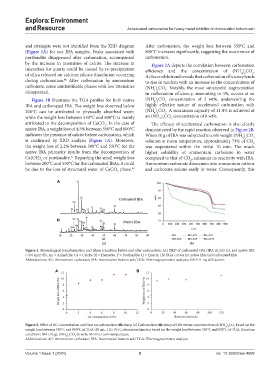
            and ettringite were not identified from the XRD diagram   After carbonation, the weight loss between 550°C and
            (Figure  1A) for our IBA samples. Peaks associated with   800°C increases significantly, suggesting the occurrence of
            portlandite disappeared after carbonation, accompanied   carbonation.
            by the increase in intensities of calcite. The increase in   Figure 2A depicts the correlation between carbonation
            intensities for quartz could be caused by re-precipitation   efficiency and  the  concentration of  (NH ) CO .
                                                                                                        4 2
                                                                                                            3
            of silica released on calcium silicate dissolution occurring   A discernible trend reveals that carbonation efficiency tends
            during carbonation.  After carbonation by ammonium   to rise in tandem with an increase in the concentration of
                            46
            carbonate, some unidentifiable phases with low intensities   (NH ) CO .  Notably,  the  most substantial  augmentation
                                                                   4 2
                                                                       3
            disapperaed.                                       in carbonation efficiency, amounting to 4%, occurs at an
              Figure 1B illustrates the TGA profiles for both native   (NH ) CO  concentration of 2 wt%, underscoring the
                                                                   4 2
                                                                       3
            IBA and carbonated IBA. The weight loss observed below   highly effective nature of accelerated carbonation with
            200°C can be attributed to physically absorbed water,   (NH ) CO . A maximum capacity of 11.4% is achieved at
                                                                   4 2
                                                                       3
            while the weight loss between 550°C and 800°C is mainly   an (NH ) CO  concentration of 8 wt%.
                                                                          3
                                                                     4 2
            attributed to the decomposition of CaCO . In the case of   The efficacy of accelerated carbonation is also clearly
                                              3
            native IBA, a weight loss of 4.5% between 550°C and 800°C   demonstrated by the rapid reaction observed in Figure 2B.
            indicates the presence of calcite before carbonation, which   When 10 g of IBA was subjected to a 6% weight (NH ) CO
                                                                                                        4 2
                                                                                                             3
            is confirmed by XRD analysis (Figure  1A). Moreover,   solution at room temperature, approximately 74% of CO
                                                                                                             2
            the weight loss of 2.2% between 300°C and 550°C for the   was sequestered within the initial 10  min. The much
            native IBA primarily results from the decomposition of   higher solubility of ammonium carbonate in water
            Ca(OH)  or portlandite.  Regarding the small weight loss   compared to that of CO , enhances its reactivity with IBA.
                               47
                  2
                                                                                  2
            between 200°C and 550°C for the carbonated IBAs, it could   Ammonium carbonate dissociates into ammonium cations
            be due to the loss of structural water of CaCO  phase.    and carbonate anions easily in water. Consequently, this
                                                         48
                                                   3
                         A
                         B


            Figure 1. Mineralogical transformation and phase transition before and after carbonation. (A) XRD of carbonated IBA (IBA-AC10) (a), and native IBA
            (<0.6 mm) (b). An = Anhydrite, Ca = Calcite, H = Hematite, P = Portlandite, Q = Quartz. (B) TGA curves for native IBA and carbonated IBA
            Abbreviations: AC: Ammonium carbonate; IBA: Incineration bottom ash; TGA: Thermogravimetric analysis; XRD: X-ray diffraction.

                         A                                 B


            Figure 2. Effect of AC concentration and time on carbonation efficiency. (a) Carbonation efficiency of IBA versus concentration of (NH ) CO  based on the
                                                                                                     3
                                                                                                 4 2
            weight loss between 550°C and 800°C of TGA (50 mL, 1 h). (b) Carbonation kinetics based on the weight loss between 550°C and 800°C of TGA. Reaction
            condition: IBA (10 g), (NH ) CO  (6 wt%, 50 mL), room temperature
                             4 2
                                 3
            Abbreviations: AC: Ammonium carbonate; IBA: Incineration bottom ash; TGA: Thermogravimetric analysis.
            Volume 1 Issue 1 (2024)                         5                                doi: 10.36922/eer.4609

