


Page 104 - EER-1-1
P. 104
Explora: Environment
            and Resource                                                         Stratification and mixed layer deepening


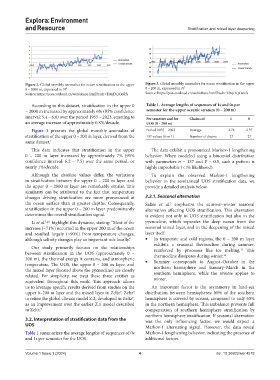
            Figure 2. Global monthly anomalies for ocean stratification in the upper   Figure 3. Global monthly anomalies for ocean stratification in the upper
            0 – 2000 m, expressed in N²                        0 – 200 m, expressed in N²
            Source: https://pan.cstcloud.cn/web/share.html?hash=E0zjDQOeRfs  Source: https://pan.cstcloud.cn/web/share.html?hash=E0zjDQOeRfs

              According to this dataset, stratification in the upper 0   Table 1. Average lengths of sequences of 1s and 0s per
            – 2000 m increased by approximately 6% (95% confidence   semester for the upper oceanic stratum (0 – 200 m)
            interval: 5.4 – 6.6) over the period 1955 – 2023, equating to   Per semester and for   Chains of  1  0
            an average increase of approximately 0.8%/decade.  UOS (0 – 200 m)
              Figure  3 presents the global monthly anomalies  of   Period 1955 – 2023  Average   2.74    2.37
            stratification of the upper 0 – 200 m layer, derived from the   137 values (0 or 1)  Number of chains  27  27
            same dataset. 1
              This data indicates that stratification in the upper   The data exhibit a pronounced Markov-1 lengthening
            0 –  200  m layer increased by approximately 7% (95%   behavior.  When  modeled  using a  binomial distribution
            confidence interval: 6.2 – 7.5) over the same period, or   with parameters  n  = 137 and  P  = 0.5, such a pattern is
            nearly 1%/decade.                                  highly improbable (<1% likelihood).
              Although the  absolute  values  differ,  the  variations   To explain the observed Markov-1 lengthening
            in stratification between the upper 0 – 200 m layer and   behavior in the semiannual UOS stratification data, we
            the upper 0 – 2000 m layer are remarkably similar. This   provide a detailed analysis below.
            similarity can be attributed to the fact that temperature
            changes driving stratification are more pronounced at   3.2.1. Seasonal alternation
            the ocean surface than at greater depths. Consequently,   Sallée  et al.  emphasize the summer-winter seasonal
                                                                         2
            stratification in the upper 0 – 200 m layer predominantly   alternation affecting UOS stratification. This alternation
            determines the overall stratification signal.      is evident not only in UOS stratification but also in the
              Li et al. 1,p.1  highlight this dynamic, stating: “Most of the   pycnocline, which separates the deep ocean from the
            increase (~71%) occurred in the upper 200 m of the ocean   seasonal mixed layer, and in the deepening of the mixed
            and resulted largely (>90%)  from  temperature changes,   layer itself.
            although salinity changes play an important role locally.”  •   In temperate and cold regions, the 0 – 200 m layer
                                                                  exhibits a seasonal thermocline during summer,
              Our study primarily focuses on the relationships                                         11
            between stratification in the UOS (approximately 0 –   reinforced by processes like ice melting.  This
                                                                  thermocline dissipates during winter.
                                                                                                12
            200 m), the thermal energy it contains, and atmospheric   •   Summer corresponds to August–October in the
            temperature. The UOS, the upper 0 – 200  m layer, and
            the mixed layer (located above the pycnocline) are closely   northern hemisphere and January–March in the
            related. For simplicity, we treat these three entities as   southern hemisphere, while the reverse applies to
                                                                  winter.
            equivalent throughout this work. This approach allows
            us to leverage specific results derived from studies on the   An  important  factor  is  the  asymmetry  in  land-sea
            upper 0–200 m layer and the mixed layer in Zeltz , Zeltz    distribution between hemispheres: 80% of the southern
                                                    7
                                                          8
            to refine the global climate model Z.2, developed in Zeltz ,   hemisphere is covered by oceans, compared to only 60%
                                                         8
            as an improvement over the earlier Z.1 model described   in the northern hemisphere. This imbalance prevents full
            in Zeltz. 7                                        compensation  of  southern  hemisphere  stratification  by
                                                               northern hemisphere stratification. If seasonal alternation
            3.2. Interpretation of stratification data from the   was the only influencing factor, we would expect a
            UOS                                                Markov-1  alternating signal. However, the  data  reveal
            Table 1 summarizes the average lengths of sequences of 0s   Markov-1 lengthening behavior, indicating the presence of
            and 1s per semester for the UOS.                   additional factors.


            Volume 1 Issue 1 (2024)                         4                                doi: 10.36922/eer.4578

