


Page 36 - EER-1-1
P. 36
Explora: Environment
            and Resource                                                 WTW emissions of road, rail, sea, and air transport


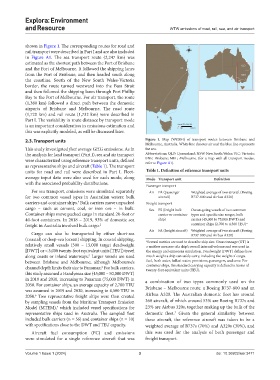
            shown in Figure 1. The corresponding routes for road and
            rail transport were described in Part I and are also included
            in  Figure A1. The sea transport route (2,247  km) was
            estimated as the shortest path between the Port of Brisbane
            and the Port of Melbourne. It followed the shipping lanes
            from the Port of Brisbane, and then headed south along
            the  coastline.  South  of  the  New  South  Wales-Victoria
            border, the route turned westward into the Bass Strait
            and then followed the shipping lanes through Port Phillip
            Bay to the Port of Melbourne. For air transport, the route
            (1,380 km) followed a direct path between the domestic
            airports of Brisbane and Melbourne. The road route
            (1,720  km)  and rail route (1,732  km) were described in
            Part I. The variability in route distance by transport mode
            is an important consideration in emissions estimation and
            this was explicitly modeled, as will be discussed later.

            2.3. Transport units                               Figure  1.  Map  (WGS84)  of  transport  routes  between  Brisbane  and
                                                               Melbourne, Australia. White line denotes air and the blue line represents
            This study investigated fleet average GHG emissions. As in   the sea.
            the analysis for land transport (Part I), sea and air transport   Abbreviations: QLD: Queensland; NSW: New South Wales; VIC: Victoria;
            were characterized using reference transport units, defined   BNE: Brisbane; MEL: Melbourne. (for a map with all transport modes,
                                                               refer to Figure A1).
            as representative ships and aircraft (Table 1). The transport
            units for road and rail were described in Part  I. Fleet-  Table 1. Definition of reference transport units
            average input data were also used for each mode, along   Mode Transport unit    Definition
            with the associated probability distributions.     Passenger transport
              For sea transport, emissions were simulated separately   Air  PA (passenger   Weighted average of two aircraft (Boeing
            for two common vessel types in Australian waters: bulk   aircraft)    B737-800 and Airbus A320)
            carriers and container ships.  Bulk carriers move unpacked   Freight transport
                                  4
            cargo – such as cement, coal, or iron ore – in bulk.   Sea  FS (freight bulk   Ocean-going vessels of two common
            Container ships move packed cargo in standard 20-foot or   carrier or container  types and specific size ranges, bulk
            40-foot containers. In 2018 – 2019, 93% of domestic sea   ship)       carrier (45,000 to 75,000 DWT) and
            freight in Australia involved bulk cargo. 2                           container ships (2,700 to 4,500 TEU) a
                                                                Air  FA (freight aircraft) Weighted average of two aircraft (Boeing
              Cargo can also be transported by either  short-sea                  B737-800 and Airbus A320)
            (coastal) or deep-sea (ocean) shipping. In coastal shipping,   a Several metrics are used to describe ship size. Gross tonnage (GT) is
            relatively small vessels (500 – 15,000 target deadweight   a unitless measure of a ship’s overall internal volume and was used in
            [DWT] or < 3,000 twenty-foot equivalent units [TEU]) travel   the energy and emissions simulation. Deadweight (DWT) defines how
            along coasts or inland waterways.  Larger vessels are used   much weight a ship can safely carry, including the weight of cargo,
                                       5
            between  Brisbane  and  Melbourne,  although  Melbourne’s   fuel, fresh water, ballast water, provisions, passengers, and crew. For
            channel depth limits their size to Panamax.  For bulk carriers,   container ships, the standard carrying capacity is defined in terms of
                                            6
                                                               twenty-foot equivalent units (TEU).
            this study assumed a Handymax size (45,000 – 50,000 DWT)
            in 2019 and 2030, increasing to Panamax (75,000 DWT) in   a combination of two types commonly used on the
            2050. For container ships, an average capacity of 2,700 TEU   Brisbane – Melbourne route: a Boeing B737-800 and an
            was assumed in 2019 and 2030, increasing to 4,500 TEU in
            2050.  Two representative freight ships were then created   Airbus A320. The Australian domestic fleet has around
                6
            by sampling vessels from the Maritime Transport Emission   360 aircraft, of which around 53% are Boeing B737s and
            Model  (MTEM),   which  included  vessel  specifications  for   23% are Airbus 320s, together making up the bulk of the
                         4
            representative ships used in Australia. The sampled fleet   domestic fleet.  Given the general similarity between
                                                                           7
            included bulk carriers (n = 56) and container ships (n = 10)   these aircraft, the reference aircraft was taken to be a
            with specifications close to the DWT and TEU capacity.  weighted average of B737s (70%) and A320s (30%), and
              Aircraft  fuel  consumption  (FC)  and  emissions   this was used for the analysis of both passenger  and
            were simulated for a single reference aircraft that was   freight transport.


            Volume 1 Issue 1 (2024)                         3                                doi: 10.36922/eer.3471

