


Page 37 - EER-1-1
P. 37
Explora: Environment
            and Resource                                                 WTW emissions of road, rail, sea, and air transport


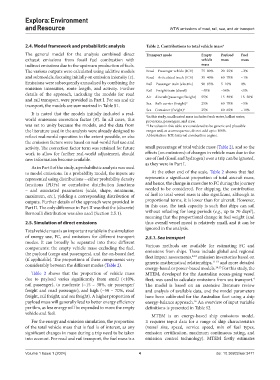
            2.4. Model framework and probabilistic analysis    Table 2. Contributions to total vehicle mass*

            The  general  model  for  the  analysis  combined  direct   Transport mode  Empty   Payload   Fuel
            exhaust emissions from fossil fuel combustion with                         vehicle   mass   mass
            indirect emissions due to the upstream production of fuels.                mass
            The various outputs were calculated using additive models   Road – Passenger vehicle (ICE)  75–80%  20–25%  ~2%
            and submodels, focusing initially on emission intensity (ε).   Road – Articulated truck (ICE)  35–40%  60–70%  ~1%
            Emissions were subsequently annualized by combining the   Rail – Passenger train (electric)  90–95%  5–10%  0%
            emission intensities, route length, and activity. Further   Rail – Freight train (diesel)  ~50%  ~50%  <1%
            details of the approach, including the models for road
            and rail transport, were provided in Part I. For sea and air   Air – Aircraft (passenger/freight)  55%  15–30%  15–30%
            transport, the models are summarized in Table S1.  Sea – Bulk carrier (freight) a  25%  60–70%  ~5%
                                                               Sea – Container (freight) a  25%  60–65%  ~10%
              It is noted that the models initially included a real-  a
                                                                In this study, unallocated mass includes fresh water, ballast water,
            world emissions correction factor (σ). In all cases, this   provisions, passengers, and crew.
            was set to unity because the models, and the data from   *The values in this table are considered to be generic and plausible
            the literature used in the analysis were already designed to   ranges and, as a consequence, do not add up to 100%.
            reflect real-world operation to the extent possible, or else   Abbreviation: ICE: Internal combustion engine.
            the emission factors were based on real-world fuel use and
            activity. The correction factor term was retained for future   small percentage of total vehicle mass (Table 2), and so the
            work  to  allow  for  further  real-world  adjustment,  should   effects (on emissions) of changes in vehicle mass due to the
            new information become available.                  use of fuel (fossil and hydrogen) over a trip can be ignored,
                                                               as they were in Part I.
              As in Part I of the study, a probabilistic analysis was used
            to model emissions. In a probability model, the inputs are   At the other end of the scale, Table 2 shows that fuel
            represented using distributions – either probability density   represents a significant proportion of total aircraft mass,
            functions (PDFs) or cumulative distribution functions   and hence, the change in mass due to FC during the journey
            – and associated parameters (scale, shape, minimum,   needed to be considered. For shipping, the contribution
            maximum, etc.), yielding a corresponding distribution of   of fuel to total vessel mass is also significant, although in
            outputs. Further details of the approach were provided in   proportional terms, it is lower than for aircraft. However,
            Part II. The only difference in Part II was that the (discrete)   in this case, the tank capacity is such that ships can sail
                                                                                                            5
            Bernoulli distribution was also used (Section 2.5.1).  without refueling for long periods (e.g., up to 70 days ),
                                                               meaning that the proportional change in fuel weight (and
            2.5. Simulation of direct emissions                thus overall vessel mass) is relatively small, and it can be
                                                               ignored in the analysis.
            Total vehicle mass is an important variable in the simulation
            of energy use, FC, and emissions for different transport   2.5.1. Sea transport
            modes. It can broadly be separated into three different
            components: the empty vehicle mass excluding the fuel,   Various methods are available for estimating FC and
            the payload (cargo and passengers), and the on-board fuel   emissions from ships. These include global and regional
                                                               fleet impact assessments,
                                                                                   8-10
                                                                                      emission inventories based on
            (if applicable). The proportions of these components vary   generic mathematical relationships, 11-13  and more detailed
            considerably between the different modes (Table 2).
                                                               energy-based or power-based models. 14,15  For this study, the
              Table 2 shows that the proportion of vehicle mass   MTEM, developed for the Australian ocean-going vessel
            due to payload varies significantly from small (<10%,   fleet, was used to calculate emissions from sea transport.
                                                                                                             4
            rail passenger), to moderate (~15 – 30%, air passenger/  The model is based on an extensive literature review
            freight and road passenger), and high (~50 – 70%, road   and analysis of available data, and the model parameters
            freight, rail freight, and sea freight). A higher proportion of   have been calibrated for the Australian fleet using a ship
            payload mass will generally lead to better energy efficiency   energy-balance approach.  An overview of input variable
                                                                                   16
            per tkm, as less energy will be expended to move the empty   definitions is presented in Table S2.
            vehicle and fuel.
                                                                 MTEM is an energy-based ship emissions model.
              For the energy and emission simulation, the proportion   It requires input data for a range of ship characteristics
            of the total vehicle mass that is fuel is of interest, as any   (vessel size, speed, service speed, mix of fuel types,
            significant changes in mass during a trip need to be taken   emission  certification,  maximum  continuous  rating,  and
            into account. For road and rail transport, the fuel mass is a   emission control technology). MTEM firstly estimates


            Volume 1 Issue 1 (2024)                         4                                doi: 10.36922/eer.3471

