


Page 42 - EER-1-1
P. 42
Explora: Environment
            and Resource                                                 WTW emissions of road, rail, sea, and air transport


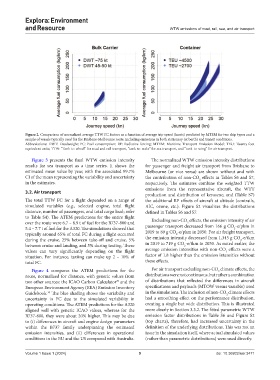
            Figure 2. Comparison of normalized average TTW FC factors as a function of average trip speed (knots) predicted by MTEM for two ship types and a
            sample of vessels typically used for the Brisbane-Melbourne route, including emissions in both stationary (at berth) and transit conditions.
            Abbreviations: DWT: Deadweight; FC: Fuel consumption; RF: Radiative forcing; MTEM: Maritime Transport Emission Model; TEU: Twenty-foot
            equivalent units; TTW: “Tank-to-wheel” for road and rail transport, “tank-to-wake” for sea transport, and “tank-to-wing” for air transport.

              Figure  3  presents  the  final  WTW  emission  intensity   The normalized WTW emission intensity distributions
            results for sea transport as a time series. It shows the   for passenger and freight air transport from Brisbane to
            estimated mean value by year, with the associated 99.7%   Melbourne (or vice versa) are shown without and with
            CI of the mean representing the variability and uncertainty   the contribution of non-CO  effects in Tables S6 and S7,
                                                                                      2
            in the estimates.                                  respectively. The estimates combine the weighted TTW
                                                               emissions from the representative aircraft, the WTT
            3.2. Air transport                                 production and distribution of kerosene, and (Table S7)
            The total TTW FC for a flight depended on a range of   the additional RF effects of aircraft at altitude (contrails,
            simulated variables (e.g., selected engine, total flight   AIC, ozone,  etc.).  Figure S2 visualizes the distributions
            distance, number of passengers, and total cargo load; refer   defined in Tables S6 and S7.
            to Table S4). The ATEM predictions for the entire flight   Excluding non-CO  effects, the emission intensity of air
            over the route were 6.7 – 8.9 t of fuel for the B737-800 and         2
            5.4 – 7.7 t of fuel for the A320. The simulations showed that   passenger transport decreased from 166 g CO -e/pkm in
                                                                                                     2
            typically around 65% of total FC during a flight occurred   2019 to 89 g CO -e/pkm in 2050. For air freight transport,
                                                                            2
            during the cruise, 25% between take-off and cruise, 5%   the emission intensity decreased from 1,345 g CO -e/tkm
                                                                                                       2
            between cruise and landing, and 5% during taxiing. These   in 2019 to 719 g CO -e/tkm in 2050. As noted earlier, the
                                                                               2
            values can vary significantly depending on the flight   average emission intensities with non-CO  effects were a
                                                                                                 2
            situation. For instance, taxiing can make up 2 – 10% of   factor of 1.8 higher than the emission intensities without
            total FC.                                          these effects.
              Figure  4 compares the ATEM predictions for the    For air transport excluding non-CO  climate effects, the
                                                                                              2
            route, normalized for distance, with generic values from   distributions were not continuous, but rather a combination
            two other sources: the ICAO Carbon Calculator  and the   of distributions that reflected the differences in aircraft
                                                   29
            European Environment Agency (EEA) Emission Inventory   specifications and payloads (MTOW versus variable) used
                     30
            Guidebook.  The blue shading shows the variability and   in the simulations. The inclusion of non-CO  climate effects
                                                                                                 2
            uncertainty in FC due to the simulated variability in   had a smoothing effect on the performance distribution,
            operating conditions. The ATEM predictions for the A320   creating a single but wide distribution. This is illustrated
            aligned well with generic ICAO values, whereas for the   more clearly in Section 3.3.2. The fitted parametric WTW
            B737-800, they were about 20% higher. This may be due   emission factor distributions in  Table S6 and  Figure S2
            to (i) differences in aircraft and engine design parameters   (top  charts), therefore, had increased uncertainty in the
            within the B737 family underpinning the estimated   definition of the underlying distributions. This was not an
            emission intensities, and (ii) differences in operational   issue in the simulation itself, where actual simulated values
            conditions in the EU and the US compared with Australia.  (rather than parametric distributions) were used directly.


            Volume 1 Issue 1 (2024)                         9                                doi: 10.36922/eer.3471

