


Page 45 - EER-1-1
P. 45
Explora: Environment
            and Resource                                                 WTW emissions of road, rail, sea, and air transport


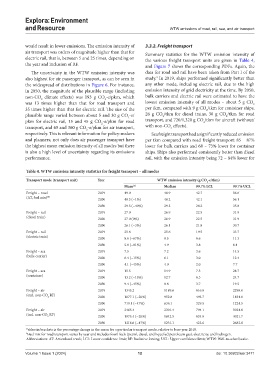
            would result in lower emissions. The emission intensity of   3.3.2. Freight transport
            air transport was orders of magnitude higher than that for   Summary statistics for the WTW emission intensity of
            electric rail, that is, between 5 and 25 times, depending on   the various freight transport units are given in  Table 4,
            the year and inclusion of RF.                      and Figure 7 shows the corresponding PDFs. Again, the
              The uncertainty in the WTW emission intensity was   data for road and rail have been taken from Part I of the
                                                                   3
            also highest for air passenger transport, as can be seen in   study.  In 2019, ships performed significantly better than
            the widespread of distributions in Figure 6. For instance,   any other mode, including electric rail, due to the high
            in 2050, the magnitude of the plausible range (including   emission intensity of grid electricity at the time. By 2050,
            non-CO  climate effects) was 193  g CO -e/pkm, which   bulk carriers and electric rail were estimated to have the
                   2
                                              2
            was 13  times higher than that for road transport and   lowest emission intensity of all modes – about 5  g CO
                                                                                                             2
            35 times higher than that for electric rail. The size of the   per tkm, compared with 9 g CO /tkm for container ships,
                                                                                         2
            plausible range varied between about 5 and 30 g CO -e/  26  g CO /tkm for diesel trains, 30  g CO /tkm for road
                                                                      2
                                                                                                 2
                                                       2
            pkm  for  electric  rail, 15  and 45  g  CO -e/pkm  for  road   transport, and 720/1,320 g CO /tkm for aircraft (without/
                                                                                        2
                                            2
            transport, and 65 and 360 g CO -e/pkm for air transport,   with non-CO  effects).
                                                                          2
                                      2
            respectively. This is relevant information for policy-makers   Sea freight transport had a significantly reduced emission
            and planners; not only does air passenger transport have   per tkm compared with road freight transport: 85 – 87%
            the highest mean emission intensity of all modes but there   lower for bulk carriers and 68 – 73% lower for container
            is also a high level of uncertainty regarding its emissions   ships. Ships also performed consistently better than diesel
            performance.                                       rail, with the emission intensity being 72 – 84% lower for
            Table 4. WTW emission intensity statistics for freight transport – all modes
            Transport mode (transport unit)  Year                   WTW emission intensity (g CO ‑e/tkm)
                                                                                         2
                                                      Mean (a)         Median       99.7% LCL       99.7% UCL
            Freight – road                 2019       49.0             48.9         42.7            56.6
            (AT, fuel mix) (b)             2030       48.3 (−1%)       48.2         42.1            56.1
                                           2050       29.5 (−40%)      29.5         24.2            35.8
            Freight – rail                 2019       27.0             26.9         22.5            31.9
            (diesel train)                 2030       27.0 (0%)        26.9         22.5            31.9
                                           2050       26.1 (−3%)       26.1         21.8            30.7
            Freight – rail                 2019       25.8             25.6         19.5            33.7
            (electric train)               2030       8.6 (−67%)       8.5          6.6             11.3
                                           2050       5.0 (−81%)       4.9          3.8             6.4
            Freight – sea                  2019       7.5              7.2          3.6             14.5
            (bulk-carrier)                 2030       6.4 (−15%)       6.1          3.0             12.4

                                           2050       4.1 (−45%)       4.0          2.0             7.7
            Freight – sea                  2019       15.5             14.9         7.5             28.7
            (container)                    2030       13.2 (−15%)      12.7         6.3             24.7

                                           2050       9.4 (−45%)       8.8          3.7             19.5
            Freight – air                  2019       1345.2           1189.6       616.6           2290.0
            (excl. non-CO  RF)             2030       1077.1 (−20%)    952.8        493.7           1834.0
                     2
                                           2050       719.1 (−47%)     636.1        329.5           1224.5
            Freight – air                  2019       2465.4           2301.4       794.1           5024.8
            (incl. non-CO  RF)
                     2                     2030       1975.4 (−20%)    1842.5       634.0           4021.7
                                           2050       1318.6 (−47%)    1231.1       423.6           2682.8
            a Value in brackets is the percentage change in the mean for a particular transport mode, relative to base year 2019.
            b Fuel mix for road transport varies by year and includes fossil fuels (petrol, diesel, and liquefied petroleum gas), electricity, and hydrogen.
            Abbreviations: AT: Articulated truck; LCL: Lower confidence limit; RF: Radiative forcing; UCL: Upper confidence limit; WTW: Well-to-wheel/wake.


            Volume 1 Issue 1 (2024)                         12                               doi: 10.36922/eer.3471

