


Page 48 - EER-1-1
P. 48
Explora: Environment
            and Resource                                                 WTW emissions of road, rail, sea, and air transport


            Table 5. Annualized WTW emissions by mode for the   the next most efficient (136–174 kt CO -e/y). In 2030 and
                                                                                              2
            Brisbane‑Melbourne route                           2050, bulk carriers and electric rail were the most efficient
                                                               modes of transport (55 – 60 CO -e/y) followed by container
            Transport mode   Year   WTW emission intensity                              2
                                       (kt CO ‑e/annum)        ships (115 – 130 kt CO -e/y). Air transport was by far
                                                                                   2
                                           2                   the least efficient, highest emitting, and most uncertain
                                 Mean  Median  99.7%   99.7%
                                               LCL   UCL       (around 11,000 – 14,000 kt CO -e/y), even though it had
                                                                                        2
            Passenger transport                                the shortest route.
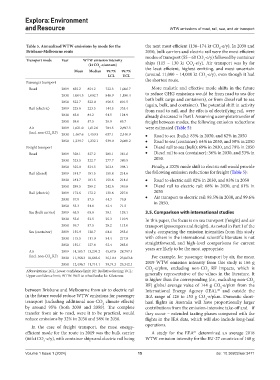
             Road          2019  855.2  854.2  722.3  1,006.7    More realistic and effective mode shifts in the future
                           2030  1,004.5  1,002.7  846.9  1,180.4  to reduce GHG emissions would be from road to sea (for
                           2050  522.7  522.0  456.5  601.5    both bulk cargo and containers), or from diesel rail to sea
                                                               (again, bulk, and container). The potential shift in activity
             Rail (electric)  2019  225.6  223.5  144.5  335.4
                                                               from road to rail, and the effects of electrifying rail, were
                           2030  85.0  84.2   54.5  124.9      already discussed in Part I. Assuming a complete transfer of
                           2050  58.0  57.5   36.9  85.7       freight between modes, the following emission reductions
             Air           2019  1,621.0  1,612.0  704.5  2,697.5  were estimated (Table 5):
             (incl. non-CO  RF)
                      2    2030  1,467.6  1,459.5  637.1  2,440.9  •   Road to sea (bulk): 83% in 2030, and 82% in 2050
                           2050  1,239.7  1,232.1  539.0  2,060.2  •   Road to sea (container): 64% in 2030, and 58% in 2050
            Freight transport                                  •   Diesel rail to sea (bulk): 69% in 2030, and 79% in 2050
             Road          2019  328.1  327.2  281.1  381.6    •   Diesel rail to sea (container): 36% in 2030, and 53% in
                           2030  323.5  322.7  277.7  380.5       2050.
                           2050  325.0  324.3  263.4  398.1      Finally, a 100% mode shift to electric rail would provide
             Rail (diesel)  2019  181.7  181.5  151.8  214.6   the following emission reductions for freight (Table 5):
                           2030  181.7  181.5  151.8  214.6    •   Road to electric rail: 82% in 2030, and 83% in 2050
                           2050  289.5  289.2  242.6  340.8    •   Diesel rail to electric rail: 68% in 2030, and 81% in
             Rail (electric)  2019  173.6  172.2  131.8  227.0    2050
                           2030  57.9  57.5   44.3  75.8       •   Air transport to electric rail: 99.5% in 2030, and 99.6%
                                                                  in 2050.
                           2050  55.3  54.8   42.4  71.5
             Sea (bulk carrier)  2019  65.5  63.0  30.1  129.1  3.5. Comparison with international studies
                           2030  55.6  53.5   25.3  110.9      In this paper, the focus is on sea transport (freight) and air
                           2050  59.7  57.5   28.2  113.0      transport (passengers and freight). As noted in Part I of the
             Sea (container)  2019  135.9  130.7  64.6  253.6  study, comparing the emission intensities from this study
                           2030  115.5  111.0  54.4  217.8     with others in the international scientific literature is not
                           2050  135.1  127.4  52.4  283.0     straightforward,  and  high-level  comparisons  for  current
             Air           2019  14,185.7 13,294.2  45,07.8 28,797.4  years are likely to be the most appropriate.
             (incl. non-CO  RF)  2030  11,366.3 10,643.6  36,10.4 23,063.8  For example, for passenger transport by air, the mean
                      2
                           2050  12,496.7 11,714.1  39,74.3 25,342.1  2019  WTW  emission  intensity  from  this  study  is  166  g
                                                               CO -e/pkm, excluding non-CO  RF impacts, which is
            Abbreviations: LCL: Lower confidence limit; RF: Radiative forcing; UCL:   generally representative of the values in the literature. It
                                                                  2
                                                                                         2
            Upper confidence limit; WTW: Well-to-wheel/wake; kt: Kilotonne.
                                                               is higher than the corresponding (i.e., excluding non-CO
                                                                                                             2
                                                               RF) global average value of 144  g CO -e/pkm from the
                                                                                               2
            between Brisbane and Melbourne from air to electric rail   International Energy Agency (IEA),  and outside the
                                                                                             60
            in the future would reduce WTW emissions for passenger   IEA range of 126 to 153 g CO -e/pkm. Domestic short-
                                                                                        2
            transport (including additional non-CO  climate effects)   haul flights in Australia will have proportionally larger
                                             2
            by around 95% (both 2030 and 2050). The complete   contributions from the emission-intensive take-off and – if
            transfer from air to road, were it to be practical, would   they occur – extended taxiing phases compared with the
            reduce emissions by 32% in 2030 and 58% in 2050.   flights in the IEA data, which will also include long-haul
              In  the case of  freight transport, the most energy-  operations.
            efficient mode for the route in 2019 was the bulk carrier   A study for the EEA  determined an average 2018
                                                                                   61
            (66 kt CO -e/y), with container ships and electric rail being   WTW emission intensity for the EU-27 countries of 160 g
                    2
            Volume 1 Issue 1 (2024)                         15                               doi: 10.36922/eer.3471

