


Page 44 - EER-1-1
P. 44
Explora: Environment
            and Resource                                                 WTW emissions of road, rail, sea, and air transport


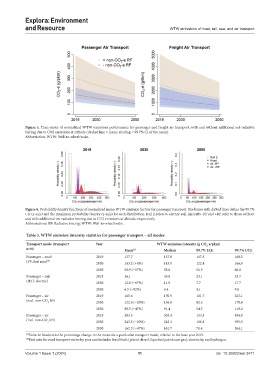
            Figure 5. Time-series of normalized WTW emissions performance for passenger and freight air transport, with and without additional net radiative
            forcing due to CO2 emissions at altitude (dashed line = mean; shading = 99.7% CI of the mean).
            Abbreviation: WTW: Well-to-wheel/wake.


            Figure 6. Probability density functions of normalized mean WTW emission factors for passenger transport. The boxes with dotted lines define the 99.7%
            CIs (x-axis) and the maximum probability density (y-axis) for each distribution. Rail E refers to electric rail. Aircrafts -RF and +RF refer to those without
            and with additional net radiative forcing due to CO2 emissions at altitude, respectively.
            Abbreviations: RF: Radiative forcing; WTW: Well-to-wheel/wake.

            Table 3. WTW emission intensity statistics for passenger transport – all modes
            Transport mode (transport     Year                      WTW emission intensity (g CO ‑e/pkm)
                                                                                         2
            unit)                                     Mean (a)         Median        99.7% LCL       99.7% UCL
            Passenger – road              2019        137.7            137.6         117.5           160.5
            (PV, fuel mix) (b)            2030        143.2 (+4%)      143.0         122.4           166.0
                                          2050        58.9 (−57%)      58.8          51.9            66.8
            Passenger – rail              2019        36.1             35.8          23.1            53.7
            (HST, electric)               2030        12.0 (−67%)      11.9          7.7             17.7
                                          2050        6.5 (−82%)       6.4           4.1             9.6
            Passenger – air               2019        165.6            170.9         101.7           223.1
            (excl. non-CO  RF)
                     2                    2030        132.6 (−20%)     136.8         81.5            178.6
                                          2050        88.5 (−47%)      91.4          54.3            119.2
            Passenger – air               2019        303.5            302.4         133.5           494.0
            (incl. non-CO  RF)            2030        243.2 (−20%)     242.3         106.8           395.5
                     2
                                          2050        162.3 (−47%)     161.7         71.4            264.1
            (a) Value in brackets is the percentage change in the mean for a particular transport mode, relative to the base year 2019.
            (b) Fuel mix for road transport varies by year and includes fossil fuels (petrol, diesel, liquefied petroleum gas), electricity, and hydrogen.

            Volume 1 Issue 1 (2024)                         11                               doi: 10.36922/eer.3471

