


Page 47 - EER-1-1
P. 47
Explora: Environment
            and Resource                                                 WTW emissions of road, rail, sea, and air transport


              The uncertainty in the WTW emission intensity was   show a gradual decline in GHG emissions, land transport
            also the highest for air transport, as can be seen in the   (rail and road) shows a more non-linear trajectory.
            widespread  of  distributions  in  Figure  7.  The  size  of  the   Road transport is expected to significantly improve its
            plausible range varied between a relatively narrow 3 – 14 g   performance after 2030  when  zero-  and low-emission
            CO -e/pkm for electric rail, 8 – 9 CO -e/pkm for diesel rail   vehicles start to penetrate the on-road fleet at an accelerated
                                         2
               2
            and 6 – 11 g CO -e/pkm for bulk carriers, to a wider 12–14 g   rate. In contrast, electric rail is decarbonizing much faster,
                        2
            CO -e/pkm for road transport, and 16–21 g CO -e/pkm for   in line with the decarbonization of the electricity grid. This
                                                 2
               2
            container ships to a very wide 895 – 4,231 g CO -e/pkm for   shows an additional important benefit of electric rail over
                                                 2
            air transport. In 2050, the plausible range for air transport   the other transport modes: it decarbonizes faster than the
            (including additional non-CO  climate effects) was 2,259 g   other modes and will, therefore, prevent a large portion of
                                    2
            CO -e/pkm, which was 195 times higher than that for road   the cumulative GHG emission loads associated with the
               2
            transport and 863 times higher than that for electric rail.  other transport modes.
            3.3.3. Summary of time-series by mode              3.4. Annualized emissions
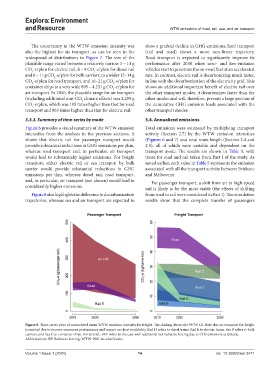
            Figure 8 provides a visual summary of the WTW emission   Total emissions were estimated by multiplying transport
            intensities from the analysis in the previous sections. It   activity (Section 2.7) by the WTW emission intensities
            shows that electric rail for passenger transport would   (Figures 6 and 7) and total route length (Section 2.4 and
            provide substantial reductions in GHG emissions per pkm,   2.5), all of which were variable and dependent on the
            whereas road transport and, in particular, air transport   transport mode. The  results are  shown in  Table 5, with
            would lead to substantially higher emissions. For freight   those for road and rail taken from Part I of the study. As
            transport, either electric rail or sea transport by bulk   noted earlier, each value in Table 5 represents the emission
            carrier would provide substantial reductions in GHG   associated with all the transport activity between Brisbane
            emissions per tkm, whereas diesel rail, road transport,   and Melbourne.
            and, in particular, air transport (not shown) would lead to   For passenger transport, a shift from air to high-speed
            considerably higher emissions.                     rail is likely to be the most viable (the effects of shifting
              Figure 8 also highlights the difference in decarbonization   from road to rail were considered in Part I). The simulation
            trajectories, whereas sea and air transport are expected to   results show that the complete transfer of passengers


            Figure 8. Time-series plots of normalized mean WTW emission intensity for freight. The shading shows the 99.7% CI. Note that air transport for freight
            is omitted due to its poor emissions performance and impact on chart readability. Rail D refers to diesel trains, Rail E to electric trains, Sea B refers to bulk
            carriers, and Sea C to container ships. For aircraft, +RF refers to the case with additional net radiative forcing due to CO2 emissions at altitude.
            Abbreviations: RF: Radiative forcing; WTW: Well-to-wheel/wake.


            Volume 1 Issue 1 (2024)                         14                               doi: 10.36922/eer.3471

