


Page 46 - EER-1-1
P. 46
Explora: Environment
            and Resource                                                 WTW emissions of road, rail, sea, and air transport


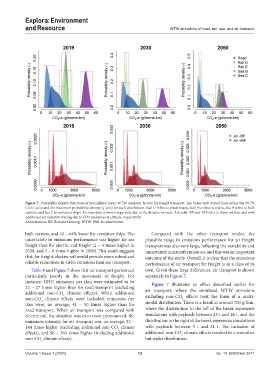
            Figure 7. Probability density functions of normalized mean WTW emission factors for freight transport. The boxes with dotted lines define the 99.7%
            CIs (x-axis) and the maximum probability density (y-axis) for each distribution. Rail D refers to diesel trains, Rail E to electric trains, Sea B refers to bulk
            carriers, and Sea C to container ships. Air transport is shown separately due to the distance in scale. Aircrafts -RF and +RF refer to those without and with
            additional net radiative forcing due to CO2 emissions at altitude, respectively.
            Abbreviations: RF: Radiative forcing; WTW: Well-to-wheel/wake.

            bulk carriers, and 43 – 64% lower for container ships. The   Compared  with  the other  transport modes, the
            uncertainty in emissions performance was higher for sea   plausible range in emissions performance for air freight
            freight than for electric rail freight (2 – 4 times higher in   transport was also very large, reflecting the variability and
            2030, and 2 – 6 times higher in 2050). This result suggests   uncertainty in aircraft emissions, and this was an important
            that, for freight, electric rail would provide more robust and   outcome of the study. Overall, it is clear that the emissions
            reliable reductions in GHG emissions than sea transport.  performance of air transport for freight is in a class of its
              Table 4 and Figure 7 show that air transport performed   own. Given these large differences, air transport is shown
            particularly  poorly  in  the  movement  of  freight.  For   separately in Figure 7.
            instance, GHG emissions per tkm were estimated to be   Figure  7 illustrates an effect described earlier for
            22 – 27 times higher than for road transport (excluding   air transport, where the simulated WTW emissions
            additional non-CO  climate effects). When additional
                            2
            non-CO  climate effects were included, emissions per   excluding  non-CO   effects  took  the  form  of  a  multi-
                                                                              2
                   2
            tkm were, on average, 41 – 50  times higher than for   modal distribution. There is a break at around 700 g/tkm,
            road transport. When air transport was compared with   where the distribution to the left of the break represents
            electric rail, the situation was even more pronounced; the   simulations with payloads between 23 t and 26 t, and the
            emissions intensity for air transport was, on average, 52 –   distribution to the right of the break represents simulations
            144 times higher (excluding additional non-CO  climate   with  payloads between  9  t and  21  t.  The  inclusion of
                                                   2
            effects), and 96 – 265 times higher (including additional   additional non-CO  climate effects resulted in a smoother
                                                                              2
            non-CO  climate effects).                          but wider distribution.
                   2
            Volume 1 Issue 1 (2024)                         13                               doi: 10.36922/eer.3471

