


Page 43 - EER-1-1
P. 43
Explora: Environment
            and Resource                                                 WTW emissions of road, rail, sea, and air transport


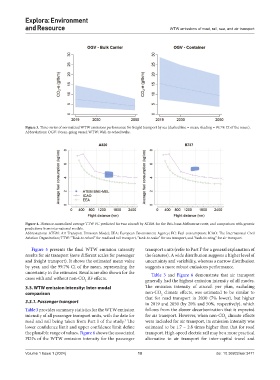
            Figure 3. Time-series of normalized WTW emissions performance for freight transport by sea (dashed line = mean; shading = 99.7% CI of the mean).
            Abbreviations: OGV: Ocean-going vessel; WTW: Well-to-wheel/wake.


            Figure 4. Distance-normalized average TTW FC predicted for two aircraft by ATEM for the Bris-bane-Melbourne route, and comparison with generic
            predictions from international models.
            Abbreviations: ATEM: Air Transport Emission Model; EEA: European Environment Agency; FC: Fuel consumption; ICAO: The International Civil
            Aviation Organization; TTW: “Tank-to-wheel” for road and rail transport, “tank-to-wake” for sea transport, and “tank-to-wing” for air transport.

              Figure  5  presents  the  final  WTW  emission  intensity   transport units (refer to Part I  for a general explanation of
                                                                                       3
            results for air transport (note different scales for passenger   the features). A wide distribution suggests a higher level of
            and freight transport). It shows the estimated mean value   uncertainty and variability, whereas a narrow distribution
            by year, and the 99.7% CI of the mean, representing the   suggests a more robust emissions performance.
            uncertainty in the estimates. Results are also shown for the   Table  3  and  Figure  6  demonstrate  that  air  transport
            cases with and without non-CO  RF effects.         generally had the highest emission intensity of all modes.
                                     2
            3.3. WTW emission intensity: Inter-modal           The emission intensity of aircraft per pkm, excluding
            comparison                                         non-CO  climate effects, was estimated to  be similar to
                                                                      2
                                                               that for road transport in  2030  (7% lower),  but higher
            3.3.1. Passenger transport                         in 2019 and 2050 (by 20% and 50%, respectively), which
            Table 3 provides summary statistics for the WTW emission   follows from the slower decarbonization that is expected
            intensity of all passenger transport units, with the data for   for air transport. However, when non-CO  climate effects
                                                                                                 2
            road and rail being taken from Part I of the study.  The   were included for air transport, its emission intensity was
                                                      3
            lower confidence limit and upper confidence limit define   estimated to be 1.7 – 2.8 times higher than that for road
            the plausible range of values. Figure 6 shows the associated   transport. High-speed electric rail may be a more practical
            PDFs of the WTW emission intensity for the passenger   alternative to air transport for inter-capital travel and


            Volume 1 Issue 1 (2024)                         10                               doi: 10.36922/eer.3471

