


Page 62 - EER-1-1
P. 62
Explora: Environment
            and Resource                                                   COVID-19 impact on forest biodiversity attitudes


                                                  Figure 1. Conceptual framework

            (1970) for sample size, the sample size of 384 respondents   questionnaire was drawn from existing literature to ensure
            with a margin error of 5% was sufficient for the targeted   validity and reliability.
            population of around 16.24 million people aged between   Participants were asked to rate the impact of COVID-19
            25 and 64 years.                                   based on statements such as: “The COVID-19 pandemic has
              Five  hundred  and  thirteen  questionnaires  were   negatively affected my physical health,” “The COVID-19
            distributed, and 505 were finalized and analyzed. The   pandemic has negatively affected my mental health,” “The
            questionnaire includes three sections: (i) demographic   COVID-19 pandemic has adversely affected my financial
            data; (ii) the impact of the COVID-19 pandemic on   status,” and “The COVID-19 pandemic has increased my
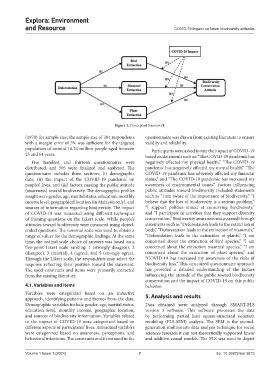
            peoples’ lives; and (iii) factors causing the public attitude   awareness of environmental issues.” Factors influencing
            (awareness) toward biodiversity. The demographic profiles   public attitudes toward biodiversity included statements
            sought were gender, age, marital status, education, monthly   such as “I am aware of the importance of biodiversity,” “I
            income level, geographical location (in Malaysia only), and   believe that the loss of biodiversity is a serious problem,”
            sources of information regarding biodiversity. The impact   “I support policies aimed at conserving biodiversity,”
            of COVID-19 was measured using different techniques   and “I participate in activities that they support diversity
            of framing questions on the Likert scale. While people’s   conservation.” Biodiversity awareness was assessed through
            attitudes toward biodiversity were measured using closed-  statements such as “Deforestation leads to the extinction of
            ended questions. The nominal scale was used to obtain a   birds,” “Deforestation leads to the extinction of mammals,”
            range of values for the demographic findings. At the same   “Deforestation leads to the extinction of plants,” “I am
            time, the ordinal scale choice of answers was based on a   concerned about the extinction of bird species,” “I am
            five-point Likert scale ranking: 1 (strongly disagree), 2   concerned about the extinction mammal species,” “I am
            (disagree), 3 (neutral), 4 (agree), and 5 (strongly agree).   concerned about the extinction of plant species,” and
            Through the Likert scale, the respondents may select the   “COVID-19 has increased my awareness of the risks of
            response reflecting their position toward the statement.   biodiversity loss.” This structured questionnaire approach
            The used constructs and items were primarily extracted   has provided a detailed understanding of the factors
            from the existing literature.                      influencing the attitude of the public toward biodiversity
                                                               conservation and the impact of COVID-19 on this public
            4.1. Variables and items                           behavior.
            Variables were categorized based on an inductive
            approach, identifying patterns and themes from the data.   5. Analysis and results
            Demographic variables include gender, age, marital status,   Data obtained were analyzed through SMART-PLS
            education  level,  monthly  income,  geographic  location,   version  3 software. This software processes the data
            and sources of biodiversity information. Variables related   by performing partial least square-structural equation
            to the impact of COVID-19 were categorized based on   modeling (PLS-SEM) analysis. The SEM  is  the second-
            different aspects of participants’ lives. Attitudinal variables   generation multivariate data analysis technique for social
            were categorized based on awareness, perceptions, and   sciences research it can test theoretically supported linear
            behavioral intentions. The constructs and items used in the   and additive causal models. The PLS was used to depict


            Volume 1 Issue 1 (2024)                         7                                doi: 10.36922/eer.3615

