


Page 63 - EER-1-1
P. 63
Explora: Environment
            and Resource                                                   COVID-19 impact on forest biodiversity attitudes


            the relationship among all latent constructs simultaneously   Table 1. Demographic profile
            while dealing with the measurement errors in the structural
            model  As this study is essentially explanatory, PLS was   Variables            Count (n=505)  %
                 57
            thus found to fit the purpose of the research. This is in line   Gender
            with research,  suggesting that the measurement models   Male                        270      53
                       57
            are investigated separately before the evaluation of the   Female                    235      47
            structural model.                                  Age

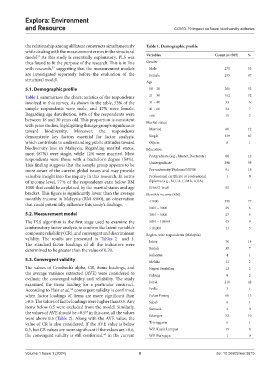
            5.1. Demographic profile                            18 – 20                          261      52
            Table 1 summarizes the characteristics of the respondents   21 – 30                  162      32
            involved in this survey. As shown in the table, 53% of the   31 – 40                 33        6
            sample  respondents  were  male,  and  47%  were  female.   41 – 60                  34        7
            Regarding age distribution, 84% of the respondents were   >60                        15        3
            between 18 and 30 years old. This proportion is consistent   Marital status
            with prior studies, highlighting this age group’s significance
            toward  biodiversity.  Moreover,  the  respondents  Married                          60       12
            demonstrate key factors essential for factor analysis,   Single                      439      87
            which contribute to understanding public attitudes toward   Others                   6         1
            biodiversity loss in Malaysia. Regarding marital status,   Education
            most (87%) were single, while 12% were married. Most   Postgraduate (e.g., Master, Doctorate)  60  12
            respondents were those with a bachelor’s degree (59%).
            This finding suggests that the sample group appears to be   Undergraduate            298      59
            more aware of the current global issues and may provide   Pre-university/Diploma/STPM  91     18
            valuable insight into the inquiry in this research. In terms   Professional certificate or professional   1  0
            of income level, 77% of the respondents earn below RM   diploma (e.g., ACCA, CIMA, ICSA)
            1000 that could be explained by the marital status and age   SPM/O-level             55       11
            bracket. This figure is significantly lower than the average   Monthly income (RM)
            monthly income in Malaysia (RM 6500), an observation   <1000                         391      77
            that could potentially influence this study’s findings.
                                                                1001 – 3000                      29        6
            5.2. Measurement model                              3001 – 5000                      27        5
            The PLS algorithm is the first stage used to examine the   5001 – 10,000             45        9
            confirmatory factor analysis to confirm the latent variable’s   >10,000              13        3
            composite reliability (CR), and convergent and discriminant   Region-wise respondents (Malaysia)
            validity. The results are presented in  Tables  2    and  3.   Johor                 70       14
            The  standard  factor  loadings of  all  the indicators  were
            determined to be greater than the value of 0.70.    Kedah                            35        7
                                                                Kelantan                         4         1
            5.3. Convergent validity                            Melaka                           11        2
            The values of Cronbach’s alpha, CR, items loadings, and   Negeri Sembilan            12        2
            the average variance extracted (AVE) were considered to   Pahang                     8         2
            evaluate the converged validity and reliability. The study
            examined the items loading for a particular construct.   Perak                       210      42
            According to Hair et al.,  convergent validity is confirmed   Perlis                 3         1
                               58
            when factor loadings of items are more significant than   Pulau Pinang               66       13
            >0.5. The values of factor loadings were higher than 0.5. Any   Sabah                6         1
            items below 0.5 were excluded from the model. Similarly,   Sarawak                   2         0
            the values of AVE should be >0.5  in this case, all the values   Selangor            52       10
                                     58
            were above 0.5 (Table 2). Along with the AVE value, the
            value of CR is also considered. If the AVE value is below   Terengganu               6         1
            0.5, but CR values are more significant if the values are >0.6,   W.P. Kuala Lumpur  19        4
            the convergent validity is still confirmed.  In the current   W.P. Putrajaya         1         0
                                             60


            Volume 1 Issue 1 (2024)                         8                                doi: 10.36922/eer.3615

