


Page 64 - EER-1-1
P. 64
Explora: Environment
            and Resource                                                   COVID-19 impact on forest biodiversity attitudes


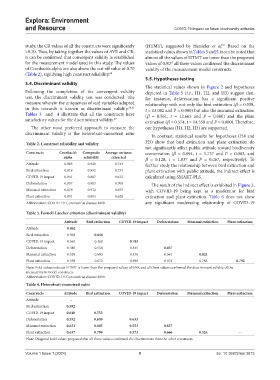
            study, the CR values of all the constructs were significantly   (HTMT),  suggested  by  Henseler  et al.   Based  on  the
                                                                                                61
            >0.70. Thus, by taking together the values of AVE and CR,   statistical values shown in Tables 3 and 5, it can be noted that
            it can be confirmed that convergent validity is established   almost all the values of HTMT are lower than the proposed
            for the measurement model used in this study. The values   values of 0.90  all these values confirmed the discriminant
                                                                          62
            of Cronbach’s alpha are also above the cut-off value of 0.70   validity of the measurement model constructs.
            (Table 2), signifying high construct reliability. 60
                                                               5.5. Hypotheses testing
            5.4. Discriminant validity
                                                               The statistical values shown in  Figure  2 and hypotheses
            Following the completion of the convergent validity   depicted in  Table  5 (i.e., H1, H2, and H3) suggest that,
            test, the discriminant validity test was conducted. The   for instance, deforestation has a significant positive
            measure wherein the uniqueness of said variables adopted   relationship with not only the bird extinction (b = 0.558,
            in this research is known as discriminant validity. 59,61    t = 13.082 and P = 0.000) but also the mammal extinction
            Tables  3   and   4 illustrate that all the constructs have   (b  =  0.561,  t  =  12.663 and  P  =  0.000) and  the  plant
            satisfactory values for the discriminant validity. 57  extinction (b = 0.574, t = 14.559 and P = 0.000). Therefore,
              The other most preferred approach to measure the   our hypotheses (H1, H2, H3) are supported.
            discriminant validity is the heterotrait–monotrait ratio
                                                                 In contrast, statistical results for hypotheses (H4 and
            Table 2. Construct reliability and validity        H5) show that bird extinction and plant extinction do
                                                               not significantly affect public attitude toward biodiversity
            Constructs    Cronbach’s   Composite   Average variance   conservation (b  =  0.094,  t  = 1.737 and  P  =  0.083, and
                            alpha    reliability  extracted    b  = 0.128,  t  =  1.837  and  P  =  0.067,  respectively).  To
            Attitude        0.885     0.920       0.743        further study the relationship between bird extinction and
            Bird extinction  0.818    0.892       0.734        plant extinction with public attitude, the indirect effect is
            COVID-19 impact  0.841    0.887       0.612        calculated using SMART-PLS.
            Deforestation   0.857     0.903       0.700          The result of the indirect effect is exhibited in Figure 3,
            Mammal extinction  0.879  0.912       0.675        with COVID-19 being kept as a moderator for bird
            Plant extinction  0.851   0.894       0.628        extinction and plant extinction.  Table  6 does not show
            Abbreviation: COVID-19: Coronavirus disease 2019.  any significant moderating relationship of COVID-19

            Table 3. Fornell‑Larcker criterion (discriminant validity)
                            Attitude  Bird extinction  COVID‑19 impact  Deforestation  Mammal extinction  Plant extinction
            Attitude          0.862
            Bird extinction   0.504      0.856
            COVID-19 impact   0.564      0.460          0.783
            Deforestation     0.485      0.558          0.545          0.837
            Mammal extinction  0.559     0.683          0.478          0.561          0.821
            Plant extinction  0.559      0.672          0.490          0.574          0.785          0.792
            Note: Bold values indicate HTMT is lower than the proposed values of 0.90, and all these values confirmed the discriminant validity of the
            measurement model constructs.
            Abbreviation: COVID-19: Coronavirus disease 2019.
            Table 4. Heterotrait‑monotrait ratio
            Constructs      Attitude  Bird extinction  COVID‑19 impact  Deforestation  Mammal extinction  Plant extinction
            Attitude           --
            Bird extinction  0.592
            COVID-19 impact  0.648       0.553
            Deforestation    0.552       0.659          0.633
            Mammal extinction  0.631     0.805          0.553          0.637
            Plant extinction  0.637      0.798          0.573          0.666          0.524            --
            Note: Diagonal bold values proposed that all these values confirmed the discriminant than the other constructs.


            Volume 1 Issue 1 (2024)                         9                                doi: 10.36922/eer.3615

