


Page 74 - EER-1-1
P. 74
Explora: Environment
            and Resource                                                               Climate change and apple yield


            in both plants and fruits. It has been reported that a shift
            in microclimatic conditions such as temperature, rainfall,
            and snowfall affects apple production. 5
              In the Indian state of Himachal Pradesh, 90% of the
            population are  engaged in  agriculture activities,  which
            generate 62% of the job opportunities in the region. The
            area of agricultural land set aside for apple cultivation has
            been continuously expanding in Himachal Pradesh with
            an average increase of 1.5% every year. 6
              Large  fruits  such  as  apple,  pear,  plum,  almond,  and
            walnut achieve optimal growth in cool winter. The
            growth of apple fruit is largely dependent on climatic
            conditions as this is evidenced by the stage-specific
            growth of the plant: dormant (December – March),
            flowering and bud formation (April – May), growth and
            development (June – September), and pre-dormant stages
            (October – November). These growth stages of apple are
            particularly vulnerable to irregular weather patterns due
            to climate change. Abnormal climatic manifestations
            like  temperature  irregularity,  a  decline  of  snow,  and
            irregular rainfall are becoming more common nowadays.
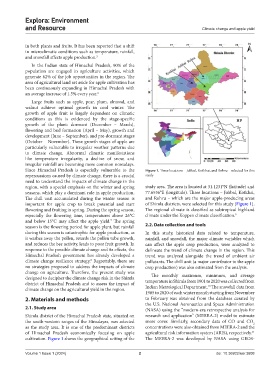
            Since  Himachal  Pradesh  is  especially  vulnerable  to  the   Figure 1. Three locations – Jubbal, Kotkhai, and Rohru – selected for this
            repercussions caused by climate change, there is a crucial   study
            need to understand the impacts of climate change in the
            region, with a special emphasis on the winter and spring   study area. The area is located at 31.1231°N (latitude) and
            seasons, which play a dominant role in apple production.   77.6536°E (longitude). Three locations – Jubbal, Kotkhai,
            The chill unit accumulated during the winter season is   and Rohru – which are the major apple-producing areas
            important for apple crop to break potential and start   of Shimla districts, were selected for this study (Figure 1).
            flowering and fruiting in spring. During the spring season,   The regional climate is classified as subtropical highland
            especially the flowering time, temperatures above 26°C   climate under the Koppen climate classification. 9
            and below 15°C may affect the apple yield.  The spring
                                                7
            season is the flowering period for apple plant, but rainfall   2.2. Data collection and tools
            during this season is catastrophic for apple production, as   In this study, historical data related to temperature,
            it washes away the pollen, retards the pollen tube growth,   rainfall, and snowfall, the major climate variables which
            and reduces the bee activity, leads to poor fruit growth. In   can affect the apple crop production, were analyzed to
            response to the possible climate change and its effects, the   delineate the trend of climate change in the region. This
            Himachal  Pradesh  government has  already  developed a   trend was analyzed alongside the trend of ambient air
            climate change resilience strategy.  Regrettably, there are   pollutants. The chill unit (a major contributor to the apple
                                        8
            no strategies proposed to address the impacts of climate   crop production) was also estimated from the analysis.
            change on agriculture. Therefore, the present study was
            designed to decipher the climate change risk in the Shimla   The  monthly  maximum,  minimum,  and  average
            district of Himachal Pradesh and to assess the impact of   temperature in Shimla from 1901 to 2020 was collected from
                                                                                         10
            climate change on the agricultural yield in the region.  Indian Metrological Department.  The snowfall data from
                                                               1985 to 2020 of each winter month starting from November
            2. Materials and methods                           to February was obtained from the database curated by
                                                               the U.S. National Aeronautics and Space Administration
            2.1. Study area                                    (NASA) using the “modern-era retrospective analysis for
            Shimla district of the Himachal Pradesh state, situated on   research and application” (MERRA-2) model to estimate
            the south-western ranges of the Himalayas, was selected   snow cover. Similarly, secondary data of CO and CO
                                                                                                             2
            as the study area. It is one of the predominant districts   concentrations were also obtained from MEERA-2 and the
            of Himachal Pradesh economically focusing on apple   agricultural risk information system (ARIS), respectively.
                                                                                                            11
            cultivation. Figure 1 shows the geographical setting of the   The MEERA-2 was developed by NASA using GEOS-

            Volume 1 Issue 1 (2024)                         2                                doi: 10.36922/eer.3608

