


Page 79 - EER-1-1
P. 79
Explora: Environment
            and Resource                                                               Climate change and apple yield


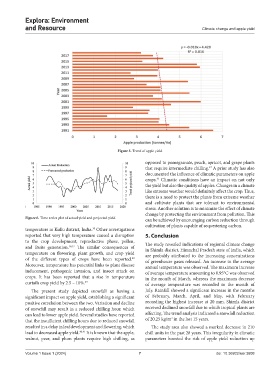
                                                   Figure 5. Trend of apple yield

                                                               opposed to pomegranate, peach, apricot, and grape plants
                                                               that require intermediate chilling.  A prior study has also
                                                                                          42
                                                               documented the influence of climatic parameters on apple
                                                               crops.  Climatic conditions have an impact on not only
                                                                    43
                                                               the yield but also the quality of apples. Changes in a climate
                                                               like extreme weather would definitely affect the crop. Thus,
                                                               there is a need to protect the plants from extreme weather
                                                               and cultivate plants that are tolerant to environmental
                                                               stress. Another solution is to minimize the effect of climate
                                                               change by protecting the environment from pollution. This
            Figure 6. Time series plot of actual yield and projected yield  can be achieved by encouraging carbon reduction through
                                                               cultivation of plants capable of sequestering carbon.
            temperature in Kullu district, India.  Other investigations
                                        35
            reported that very high temperature caused a disruption   5. Conclusion
            to the crop development, reproductive phase, pollen,   The study revealed indications of regional climate change
            and fruits generation. 36,37  The similar consequences of   in Shimla district, Himachal Pradesh state of India, which
            temperature on flowering, plant growth, and crop yield   are probably attributed to the increasing concentrations
            of the different types of crops have been reported.    of greenhouse gases released. An increase in the average
                                                         38
            Moreover, temperature has potential links to plant disease   annual temperature was observed. The maximum increase
            inducement, pathogenic invasion, and insect attack on   of average temperature amounting to 0.95°C was observed
            crops. It has been reported that a rise in temperature   in the month of March, whereas the maximum decrease
            curtails crop yield by 2.5 – 10%. 39               of average temperature was recorded in the month of
              The present study depicted snowfall as having a   July. Rainfall showed a significant increase in the months
            significant impact on apple yield, establishing a significant   of February, March, April, and May, with February
            positive correlation between the two. Variation and decline   recording the highest increase at 20 mm. Shimla district
            of snowfall may result in a reduced chilling hour, which   received declined snowfall due to which tropical plants are
            can lead to lower apple yield. Several studies have reported   affecting. The trend analysis indicated a snowfall reduction
                                                                          2
            that the insufficient chilling hours due to reduced snowfall   of 20.25 kg/m  in the last 15 years.
            resulted in a delay in leaf development and flowering, which   The study area also showed a marked decrease in 210
            lead to decreased apple yield. 40,41  It is known that the apple,   chill units in the past 28 years. This irregularity in climatic
            walnut, pear, and plum plants require high chilling, as   parameters boosted the risk of apple yield reduction up


            Volume 1 Issue 1 (2024)                         7                                doi: 10.36922/eer.3608

