


Page 77 - EER-1-1
P. 77
Explora: Environment
            and Resource                                                               Climate change and apple yield


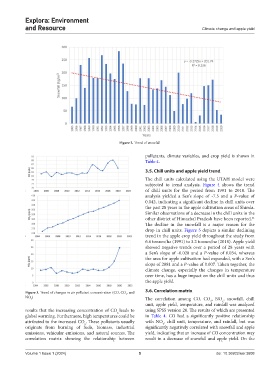
                                                    Figure 2. Trend of snowfall


                                                               pollutants, climate variables, and crop yield is shown in
                                                               Table 4.

                                                               3.5. Chill units and apple yield trend
                                                               The chill units calculated using the UTAH model were
                                                               subjected to trend analysis.  Figure  4 shows the trend
                                                               of chill units for the period from 1991 to 2018. The
                                                               analysis yielded a Sen’s slope of  -7.5 and a P-value of
                                                               0.042, indicating a significant decline in chill units over
                                                               the past 28 years in the apple cultivation areas of Shimla.
                                                               Similar observations of a decrease in the chill units in the
                                                               other district of Himachal Pradesh have been reported.
                                                                                                            31
                                                               The decline in the snowfall is a major reason for the
                                                               drop in chill units. Figure 5 depicts a similar declining
                                                               trend in the apple crop yield throughout the study from
                                                               6.6 tonnes/ha (1991) to 3.2 tonnes/ha (2018). Apple yield
                                                               showed negative trends over a period of 28  years with
                                                               a Sen’s slope of -0.028 and a P-value of 0.034, whereas
                                                               the area for apple cultivation had expanded, with a Sen’s
                                                               slope of 2081 and a P-value of 0.007. Taken together, the
                                                               climate change, especially the changes in temperature
                                                               over time, has a huge impact on the chill units and thus
                                                               the apple yield.

            Figure 3. Trend of changes in air pollutant concentration (CO, CO , and   3.6. Correlation matrix
                                                       2
            NO )
              x                                                The correlation among CO, CO , NO , snowfall, chill
                                                                                                x
                                                                                          2
                                                               unit, apple yield, temperature, and rainfall was analyzed
            results that the increasing concentration of CO leads to   using SPSS version 20. The results of which are presented
                                                   x
            global warming. Furthermore, high temperatures could be   in  Table  4.  CO had  a  significantly positive  relationship
            attributed to the increased CO . These pollutants usually   with NO , chill unit, temperature, and rainfall, but was
                                                                      x
                                     x
            originate from burning of fuels, biomass, industrial   significantly negatively correlated with snowfall and apple
            emissions, vehicular emissions, and natural sources. The   yield, indicating that an increase of CO concentration may
            correlation matrix showing the relationship between   result in a decrease of snowfall and apple yield. On the
            Volume 1 Issue 1 (2024)                         5                                doi: 10.36922/eer.3608

