


Page 23 - EER-2-2
P. 23
Explora: Environment
            and Resource                                                        Trace elements in Mediterranean mussels


            contribute to increased baseline levels of bioavailability of   effectiveness  of  using  mussels  as  bioindicators  to  assess
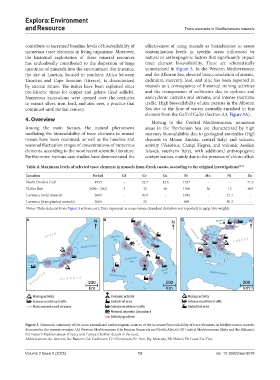
            numerous trace elements in living organisms. Moreover,   contamination levels in specific areas influenced by
            the historical exploitation of these mineral resources   natural or anthropogenic factors that significantly impact
            has  undoubtedly  contributed  to  the  dispersion  of  large   trace element bioavailability. These are schematically
            quantities of minerals into the environment. For instance,   summarized in  Figure  3. In the Western Mediterranean
            the site of Laurion, located in southern Attica between   and the Alboran Sea, elevated bioaccumulation of arsenic,
            Thoricus and Cape Sounion (Greece), is characterized   cadmium, mercury, lead, and zinc has been reported in
            by ancient mines. The mines have been exploited since   mussels as a consequence of historical mining activities
            pre-historic times for copper and galena (lead sulfide).   and the resuspension of sediments due to cyclonic and
            Numerous  excavations  were  opened  over the  centuries   anticyclonic currents and streams, and intense maritime
            to extract silver, iron, lead, and zinc ores, a practice that   traffic. High bioavailability of zinc persists in the Alboran
            continued until the last century.                  Sea due to the flow of waters naturally enriched in this
                                                               element from the Gulf of Cadiz (Section 3.3, Figure 3A).
            4. Overview                                          Moving to the Central Mediterranean, numerous
            Among the main focuses, the natural phenomena      areas in the Tyrrhenian Sea are characterized by high
            mediating the bioavailability of trace elements in mussel   mercury bioavailability due to geological anomalies (HgS
            tissues have been examined, as well as the baseline and   deposits in Mount Amiata, central Italy) and volcanic
            seasonal fluctuation ranges of concentrations of numerous   activity (Vesuvius, Campi Flegrei, and volcanic Aeolian
            elements, according to the most recent scientific literature.   Islands,  southern  Italy),  with  additional  anthropogenic
            Furthermore, various case studies have demonstrated the   contamination, mainly due to the presence of chloro-alkali

            Table 4. Maximum levels of selected trace elements in mussels from Greek coasts, according to the original investigations 59‑61
            Location                    Period       Cd       Cr      Cu       Fe       Mn        Ni      Zn
            North Evoikos Gulf           1993         -      32.7     12.6     1557      -        -       71.9
            Elefsis Bay a              2000 – 2001    4       32       60      1500      50       12      600
            Larymna (wild mussels)       2006         -      20.9      -       1082      -       21.1      -
            Larymna (transplanted mussels)  2006      -       25       -       898       -       50.3      -
            Notes:  Data deduced from Figure 3 reference 61; Data expressed as mean values (standard deviation not reported) in µg/g (dry weight).
                 a
            A                                B                                C


            Figure 3. Schematic summary of the main natural and anthropogenic sources of the increased bioavailability of trace elements in Mediterranean mussels
            discussed in the present revision: (A) Western Mediterranean (the Iberian Peninsula and North Africa); (B) Central Mediterranean (Italy and the Balkans);
            (C) Eastern Mediterranean (Greece and Turkey) (further details in the text).
            Abbreviations: As: Arsenic; Ba: Barium; Cd: Cadmium; Cr: Chromium; Fe: Iron; Hg: Mercury; Ni: Nickel; Pb: Lead; Zn: Zinc.


            Volume 2 Issue 2 (2025)                         13                               doi: 10.36922/eer.8078

