


Page 18 - EER-2-2
P. 18
Explora: Environment
            and Resource                                                        Trace elements in Mediterranean mussels


            temporal pattern, with arsenic levels increasing from 2001
            to 2002 before subsequently decreasing. Overall, the range
            of arsenic concentrations measured in the tissues of  M.
            galloprovincialis varied from a minimum of approximately
            8 µg/g to over 40 µg/g (dry weight).  Oceanographic factors,
                                       4
            including  salinity,  nutrient  concentrations,  and  water
            circulation, were identified as significant contributors to
            arsenic bioaccumulation.
              The oceanographic characteristics of the northern
            and central Adriatic are typically marked by elevated
            variability in environmental conditions, largely due to
            the combined and changing influence of the Po River
            runoff, nutrient loads, atmospheric conditions, water
            circulation, and stratification. The northern Adriatic is
            generally more influenced by river inputs: surface waters
            have reduced salinity (32 – 37%) and are supersaturated
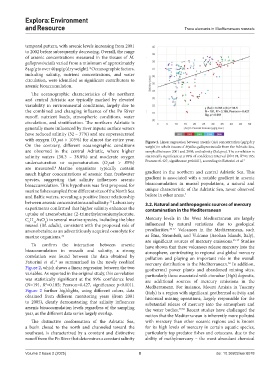
            with oxygen (O sat > 105%) for almost the entire year.   Figure 2. Linear regression between arsenic (As) concentration (µg/g dry
                         2
            On the contrary, different oceanographic conditions   weight) in whole tissues of Mytilus galloprovincialis from the Adriatic Sea,
            are observed in the central Adriatic, where higher   sampled between 2001 and 2005, and salinity (Sal; psu). The correlation is
                                                                                                        2
            salinity  waters  (38.3  –  38.8%)  and  moderate  oxygen   statistically significant at a 99% of confidence interval (N=191, R =0.185;
            undersaturation or supersaturation (O sat >  85%)   Pearson=0.427, significance p<0.001), according to Fattorini et al. 4
                                               2
            are measured. Marine organisms typically contain
                        4
            much higher concentrations of arsenic than freshwater   gradient in the northern and central Adriatic Sea. This
            species,  suggesting  that  salinity  influences  arsenic   gradient is associated with a notable gradient in arsenic
            bioaccumulation. This hypothesis was first proposed for   bioaccumulation in mussel populations, a natural and
            marine fishes sampled from different sites of the North Sea   unique characteristic of the Adriatic Sea, never observed
            and Baltic waters, revealing a positive linear relationship   before in other areas. 4
            between arsenic concentrations and salinity.  Laboratory   3.2. Natural and anthropogenic sources of mercury
                                                33
            experiments confirmed that higher salinity enhances the   contamination in the Mediterranean
            uptake of arsenobetaine (2-trimethylarsoniumylacetate,
            C H AsO ) in several marine species, including the blue   Mercury levels in the West Mediterranean are largely
               11
             5
                    2
            mussel (M. edulis), consistent with the proposed role of   influenced by natural variations due to geological
            arsenobetaine as an adventitiously acquired osmolyte for   peculiarities. 34-37   Volcanoes  in  the  Mediterranean,  such
            marine organisms. 31                               as Etna, Stromboli, and Vulcano (Aeolian Islands, Italy),
                                                               are significant  sources of  mercury  emissions. 35-37  Studies
              To confirm the interaction between arsenic       have shown that these volcanoes release mercury into the
            bioaccumulation in mussels and salinity, a strong   atmosphere, contributing to regional and global mercury
            correlation was found between the data obtained by   pollution and playing an important role in the overall
            Fattorini  et al.,   as  summarized  in  the  newly  reedited   mercury distribution in the Mediterranean.  In addition,
                         4
                                                                                                  36
            Figure 2, which shows a linear regression between the two   geothermal power plants and abandoned mining sites,
            variables. As reported in the original study, this correlation   particularly those associated with cinnabar (HgS) deposits,
            was statistically significant at the 99% confidence level   are additional sources of mercury emissions in the
                    2
            (N=191, R =0.185; Pearson=0.427, significance p<0.001).   Mediterranean. For instance, Mount Amiata in Tuscany
            Figure  2 further highlights, using different colors, data   (Italy) is a region with significant geothermal activity and
            obtained from different monitoring years (from 2001   historical mining operations, largely responsible for the
            to 2005), clearly demonstrating that salinity influences   substantial release of mercury into the atmosphere and
            arsenic bioaccumulation levels regardless of the sampling   the water bodies. 37,38  Recent studies have challenged the
            year, as the different data series largely overlap.  notion that the Mediterranean is inherently more polluted
              The distinctive conformation of the Adriatic Sea,   with mercury than other oceanic regions and is known
            a basin closed to the north and channeled toward the   for its high levels of mercury in certain aquatic species,
            southeast, is characterized by a  constant and distinctive   particularly top predator fishes and cetaceans, due to the
            runoff from the Po River that determines a constant salinity   ability of methylmercury – the most abundant chemical


            Volume 2 Issue 2 (2025)                         8                                doi: 10.36922/eer.8078

