


Page 21 - EER-2-2
P. 21
Explora: Environment
            and Resource                                                        Trace elements in Mediterranean mussels


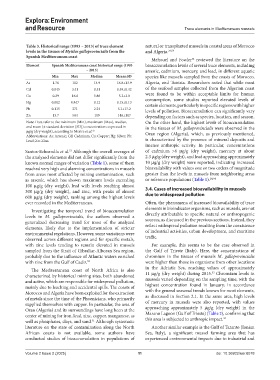
            Table 3. Historical range (1993 – 2013) of trace element   natural or transplanted mussels in coastal areas of Morocco
            levels in the tissues of Mytilus galloprovincialis from the   and Algeria. 24,54
            Spanish Mediterranean coast
                                                                 Mehouel and Fowler  reviewed the literature on the
                                                                                   54
            Element    Spanish Mediterranean coast historical range (1993   bioaccumulation levels of several trace elements, including
                                      – 2013)                  arsenic, cadmium, mercury, and lead, in different aquatic
                       Min     Max      Median    Mean±SD      species like mussels sampled from the coasts of Morocco,
            As         1.76     112      14.9      16.8±13.9   Algeria, and Tunisia. Researchers noted that while most
            Cd         0.045    3.41     0.51      0.59±0.42   of the seafood samples collected from the Algerian coast
            Cu         0.29     16.6     5.86       5.3±3.0    were found to be within acceptable limits for human
            Hg         0.002   0.847     0.12      0.15±0.13   consumption, some studies reported elevated levels of
                                                               certain elements, particularly in specific regions with higher
            Pb         0.115    271      2.24      5.1±17.2    levels of pollution. Bioaccumulation can significantly vary
            Zn         13.7     584      119       146±107     depending on factors such as species, location, and season.
            Note: Data refer to the minimum (Min), maximum (Max), median,   On the other hand, the highest levels of bioaccumulation
            and mean (± standard deviation [SD]) concentrations expressed in   in the tissues of M. galloprovincialis were observed in the
            µg/g (dry weight), according to Mestre et al. 52   Oran region (Algeria), which, as previously mentioned,
            Abbreviations: As: Arsenic; Cd: Cadmium; Cu: Copper; Hg: Silver; Pb:
            Lead; Zn: Zinc.                                    is characterized by the presence of mineral deposits and
                                                               intense anthropic activity. In particular, concentrations
            Santos-Echeandía et al.  Although the overall averages of   of cadmium >6  µg/g (dry weight), mercury at about
                              53
            the analyzed elements did not differ significantly from the   2.3 µg/g (dry weight), and lead approaching approximately
            known normal ranges of variation (Table 1), some of them   10 µg/g (dry weight) were reported, indicating increased
            reached very high and alarming concentrations in mussels   bioavailability with values one or two orders of magnitude
            from areas most affected by mining contamination, such   greater than the levels in mussels from neighboring areas
            as  arsenic,  which  has  shown  maximum  levels  exceeding   or reference populations (Table 1). 24,54
            100  µg/g (dry weight), lead with levels reaching almost
            300  µg/g (dry weight), and zinc, with peaks of almost   3.4. Cases of increased bioavailability in mussels
            600 µg/g (dry weight), ranking among the highest levels   due to widespread pollution
            ever recorded in the Mediterranean.                Often, the phenomena of increased bioavailability of trace
              Investigating the temporal trend of bioaccumulation   elements in bioindicator organisms, such as mussels, are not
            levels in  M. galloprovincialis, the authors observed a   directly attributable to specific natural or anthropogenic
            generalized decreasing trend for most of the analyzed   sources, as discussed in the previous sections. Instead, they
                                                               reflect widespread pollution resulting from the coexistence
            elements, likely due to the implementation of stricter
            environmental regulations. However, some variations were   of industrial activities, urban development, and maritime
            observed across different regions and for specific metals,   traffic.
            with zinc levels tending to remain elevated in mussels   For example, this seems to be the case observed  in
            sampled from the Strait of Gibraltar-Alboran Sea region,   the Gulf of Trieste (Italy). Here, the concentrations of
            probably due to the influence of Atlantic waters enriched   chromium in the tissues of mussels  M. galloprovincialis
            with zinc from the Gulf of Cadiz. 53               were higher than those in organisms from other locations
                                                               in  the  Adriatic  Sea,  reaching  values  of  approximately
              The  Mediterranean  coast  of  North  Africa  is  also                       53
            characterized by historical mining sites, both abandoned   11 µg/g (dry weight) during 2015.  Chromium levels in
            and active, which are responsible for widespread pollution,   mussels varied depending on the sampling time, with the
            mainly due to leaching and accidental spills. The coasts of   highest concentration  found in  January, in  accordance
            Morocco and Algeria have been exploited for the extraction   with the general seasonal trends known for most elements,
            of metals since the time of the Phoenicians, who primarily   as discussed in Section 2.1. In the same area, high levels
            supplied themselves with copper. In particular, the area of   of  mercury  in  mussels  were also reported,  with  values
            Oran (Algeria) and its surroundings have long been at the   approaching approximately 5  µg/g (dry weight) in the
            center of mining for iron, lead, zinc, copper, manganese, as   Marano Lagoon (Gulf of Trieste) (Table 2), confirming that
                                                                                                44
                                        51
            well as phosphates, clays, and sand.  Although systematic   this area is subjected to anthropic impact.
            literature on the state of contamination along the North   Another similar example is the Gulf of Taranto (Ionian
            African coasts is not available, some authors have   Sea, Italy), a significant mussel farming area that has
            conducted studies  of bioaccumulation in  populations  of   experienced environmental impacts due to industrial and


            Volume 2 Issue 2 (2025)                         11                               doi: 10.36922/eer.8078

