


Page 16 - EER-2-2
P. 16
Explora: Environment
            and Resource                                                        Trace elements in Mediterranean mussels


            Table 1. (Continued)
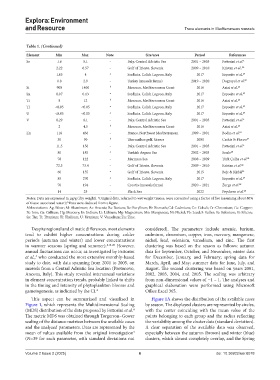
            Element      Min        Max       Note             Site/area            Period        References
            Se           1.6        5.1         -      Italy, Central Adriatic Sea  2001 – 2005  Fattorini et al. 4
                         2.22       6.57        -      Gulf of Trieste, Slovenia  2009 – 2010   Kristan et al., 22
                         1.65        4          a      Sardinia, Calich Lagoon, Italy  2017     Esposito et al. 25
                         0.8        2.9         -      Turkey (mussels farms)     2019 – 2020   Dogruyol et al. 27
            Si           900        1400        b      Morocco, Mediterranean Coast  2016       Azizi et al. 24
            Sn           0.07       0.13        a      Sardinia, Calich Lagoon, Italy  2017     Esposito et al. 25
            Ti            8          12         b      Morocco, Mediterranean Coast  2016       Azizi et al. 24
            Tl           <0.05      <0.05       a      Sardinia, Calich Lagoon, Italy  2017     Esposito et al. 25
            U            <0.05      <0.05       a      Sardinia, Calich Lagoon, Italy  2017     Esposito et al. 25
            V            0.29       8.1         -      Italy, Central Adriatic Sea  2001 – 2005  Fattorini et al. 4
                          2         4.5         b      Morocco, Mediterranean Coast  2016       Azizi et al. 24
            Zn           116        436         -      France, Northwest Mediterranean  1999 – 2001  Bodin et al. 18
                          30         90         b      Thermaikos gulf, Greece       2000       Caskie & Florou 19
                         11.5       156         -      Italy, Central Adriatic Sea  2001 – 2005  Fattorini et al. 4
                          80        185         a      Turkish Aegean Sea         2002 – 2003   Sunlu 20
                          78        122         -      Marmara Sea                2008 – 2009   Türk Çulha et al. 21
                         72.3       73.4        -      Gulf of Trieste, Slovenia  2009 – 2010   Kristan et al. 22
                          60        155         a      Gulf of Trieste, Slovenia     2015       Bajc & Kirbiš 23
                          85        270         a      Sardinia, Calich Lagoon, Italy  2017     Esposito et al. 25
                          76        194         -      Croatia (mussels farms)    2020 – 2021   Žurga et al. 28
                          14         25         -      Black Sea                     2022       Peycheva et al. 26
            Notes: Data are expressed in µg/g (dry weight).  Original data, referred to wet weight tissues, were converted using a factor of five (assuming about 80%
                                           a
            of tissue-associated water);  Data were deduced from a figure.
                              b
            Abbreviations: Ag: Silver; Al: Aluminum; As: Arsenic; Ba: Barium; Be: Beryllium; Bi: Bismuth; Cd: Cadmium; Co: Cobalt; Cr: Chromium; Cu: Copper;
            Fe: Iron; Ga: Gallium; Hg: Mercury; In: Indium; Li: Lithium; Mg: Magnesium; Mn: Manganese; Ni: Nickel; Pb: Lead; S: Sulfur; Se: Selenium; Si: Silicon;
            Sn: Tin; Ti: Titanium; Tl: Thallium; U: Uranium; V: Vanadium; Zn: Zinc.
              Despite regional and climatic differences, most elements   considered). The parameters include arsenic, barium,
            tend to exhibit higher concentrations during colder   cadmium, chromium, copper, iron, mercury, manganese,
            periods (autumn and winter) and lower concentrations   nickel, lead, selenium, vanadium,  and zinc. The first
            in  warmer  seasons  (spring  and  summer). 4,18-28   However,   clustering was based on the season as follows: autumn
            annual fluctuations can occur, as investigated by Fattorini   data for September, October, and November; winter data
            et al.,  who conducted the most extensive monthly-based   for December, January, and February; spring data for
                4
            study to date, with data spanning from 2001 to 2005, on   March, April, and May; summer data for June, July, and
            mussels from a Central Adriatic Sea location (Protonovo,   August. The second clustering was based on years 2001,
            Ancona, Italy). This study revealed interannual variations   2002, 2003, 2004, and 2005. The scaling was arbitrary
            in element concentration trends, probably linked to shifts   from non-dimensional values of −1 – 1. The analyses and
            in the timing and intensity of phytoplankton blooms and   graphical elaboration were performed using Microsoft
            gametogenesis, as indicated by the CI. 4           Office Excel 365.

              This aspect can be summarized and visualized in    Figure 1A shows the distribution of the available cases
            Figure 1, which represents the Multidimensional Scaling   by season. The displayed clusters are represented by circles,
            (MDS) distribution of the data proposed by Fattorini et al.    with the center coinciding with the mean value of the
                                                          4
            The metric MDS was obtained through Torgerson–Gower   points belonging to each group and the radius reflecting
            scaling of the distance matrices between the available cases   the variability among the cluster data (standard deviation).
            and the analyzed parameters. Data are represented by the   A  clear separation of the available data was observed,
            mean of values available from the original investigation    especially between the autumn (brown) and winter (blue)
                                                          4
            (N=39  for  each  parameter,  with  standard  deviations  not   clusters, which almost completely overlap, and the Spring

            Volume 2 Issue 2 (2025)                         6                                doi: 10.36922/eer.8078

