


Page 19 - EER-2-2
P. 19
Explora: Environment
            and Resource                                                        Trace elements in Mediterranean mussels


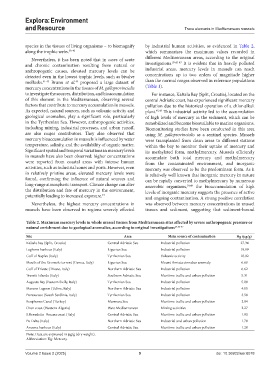
            species in the tissues of living organisms – to biomagnify   by industrial human activities, as evidenced in  Table  2,
            along the trophic webs. 38-40                      which summarizes the maximum values recorded in
              Nevertheless, it has been noted that in cases of acute   different  Mediterranean areas,  according  to the  original
            and chronic contamination resulting from natural or   investigations. 29,43-47  It is evident that in heavily polluted
            anthropogenic causes, elevated mercury levels can be   industrial areas, mercury levels in  mussels can reach
            detected even in the lowest trophic levels, such as bivalve   concentrations up to two orders of magnitude higher
            mollusks. 41-43  Bruno  et al.  proposed a large dataset of   than the normal ranges observed in reference populations
                                 44
            mercury concentrations in the tissues of M. galloprovincialis   (Table 1).
            to investigate the sources, distribution, and bioaccumulation   For instance, Kaštela Bay (Split, Croatia), located on the
            of this element in the Mediterranean, observing several   central Adriatic coast, has experienced significant mercury
            factors that contribute to mercury accumulation in mussels.   pollution due to the historical operation of a chlor-alkali
            As expected, natural sources, such as volcanic activity and   plant. 45,48  This industrial activity led to the accumulation
            geological anomalies, play a  significant role, particularly   of high levels of mercury in the sediment, which can be
            in the Tyrrhenian Sea. However, anthropogenic activities,   remobilized and become bioavailable to marine organisms.
            including mining, industrial processes, and urban runoff,   Biomonitoring studies have been conducted in this area
            are also major contributors. They also observed that   using  M. galloprovincialis as a sentinel species. Mussels
            mercury bioaccumulation in mussels is influenced by water   were transplanted from clean areas to different stations
            temperature, salinity, and the availability of organic matter.   within the bay to monitor their uptake of mercury and
            Significant spatial and temporal variations in mercury levels   its methylated form, methylmercury. Mussels efficiently
            in mussels have also been observed: higher concentrations   accumulate both total mercury and methylmercury
            were reported from coastal areas with intense human   from the contaminated environment, and inorganic
            activities, such as industrial zones and ports. However, even   mercury was observed to be the predominant form. As it
            in relatively pristine areas, elevated mercury levels were   is relatively well known that inorganic mercury in nature
            found, confirming the influence of natural sources and   can be rapidly converted to methylmercury by numerous
            long-range atmospheric transport. Climate change can alter   anaerobic organisms, 39,49  the bioaccumulation of high
            the distribution and fate of mercury in the environment,   levels of inorganic mercury suggests the presence of active
            potentially leading to increased exposure. 44      and ongoing contamination. A strong positive correlation
              Nevertheless, the highest mercury concentrations in   was observed between mercury concentrations in mussel
            mussels  have  been  observed  in  regions  severely  affected   tissues and sediment, suggesting that sediment-bound

            Table 2. Maximum mercury levels in whole mussel tissues from Mediterranean sites affected by severe anthropogenic pressure or
            natural enrichment due to geological anomalies, according to original investigations 29,43-47
            Site                                      Area               Main source of contamination  Hg (µg/g)
            Kaštela bay (Split, Croatia)       Central Adriatic Sea  Industrial pollution              27.34
            Leghorn harbour (Italy)            Ligurian Sea          Industrial pollution              19.99
            Gulf of Naples (Italy)             Tyrrhenian Sea        Volcanic activity                 10.02
            Mouth of the Gromolo torrent (Genoa, Italy)  Ligurian Sea  Mount Amiata cinnabar anomaly    6.69
            Gulf of Trieste (Trieste, Italy)   Northern Adriatic Sea  Industrial pollution              6.62
            Tremiti Islands (Italy)            Southern Adriatic Sea  Maritime traffic and urban pollution  5.31
            Augusta Bay (Eastern Sicily, Italy)  Tyrrhenian Sea      Industrial pollution               5.00
            Marano Lagoon (Udine, Italy)       Northern Adriatic Sea  Industrial pollution              4.85
            Portoscuso (South Sardinia, Italy)  Tyrrhenian Sea       Industrial pollution               3.58
            Bosphorus Canal (Turkey)           Marmara Sea           Maritime traffic and urban pollution  2.94
            Oran coast (Western Algeria)       West Mediterranean    Mining activities                  2.27
            S.Benedetto-Pescara coast (Italy)  Central Adriatic Sea  Maritime traffic and urban pollution  1.93
            Po Delta (Italy)                   Northern Adriatic Sea  Industrial and urban pollution    1.70
            Ancona harbour (Italy)             Central Adriatic Sea  Maritime traffic and urban pollution  1.20
            Note: Data are expressed in µg/g (dry weight).
            Abbreviation: Hg: Mercury.


            Volume 2 Issue 2 (2025)                         9                                doi: 10.36922/eer.8078

