


Page 117 - EJMO-9-1
P. 117
Eurasian Journal of Medicine and
            Oncology
                                                                                         HEART and SYNTAX scores


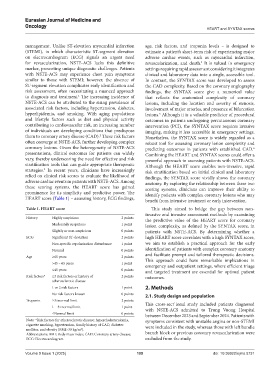
            management. Unlike ST-elevation myocardial infarction   age, risk factors, and troponin levels – is designed to
            (STEMI),  in  which  characteristic  ST-segment  elevation   estimate a patient’s short-term risk of experiencing major
            on electrocardiogram (ECG) signals an urgent need   adverse cardiac events, such as myocardial infarction,
            for  revascularization,  NSTE-ACS  lacks  this  definitive   revascularization, and death.  It is valued in emergency
                                                                                       4
            marker, presenting unique diagnostic challenges. Patients   settings requiring rapid assessment considering it integrates
            with NSTE-ACS may experience chest pain symptoms   clinical and laboratory data into a single, accessible tool.
            similar to those with STEMI; however, the absence of   In  contrast,  the  SYNTAX score was  developed to  assess
            ST-segment elevation complicates early identification and   the CAD complexity. Based on the coronary angiography
            risk assessment, often necessitating a nuanced approach   findings, the SYNTAX score give a numerical value
            to diagnosis and treatment.  The increasing incidence of   that  reflects  the  anatomical  complexity of  coronary
                                  1
            NSTE-ACS can be attributed to the rising prevalence of   lesions,  including  the  location  and  severity  of  stenosis,
            associated risk factors, including hypertension, diabetes,   involvement of major arteries, and presence of bifurcation
            hyperlipidemia, and smoking. With aging populations   lesions.  Although it is a valuable predictor of procedural
                                                                     5
            and lifestyle factors such as diet and physical activity   outcomes in patients undergoing percutaneous coronary
            contributing to cardiovascular risk, an increasing number   intervention (PCI), the SYNTAX score requires invasive
            of individuals are developing conditions that predispose   imaging, making it less accessible in emergency settings.
            them to coronary artery disease (CAD).  These risk factors   Nonetheless, the SYNTAX score is widely regarded as a
                                           2
            often converge at NSTE-ACS, further developing complex   robust tool for assessing coronary lesion complexity and
            coronary lesions. Given the heterogeneity of NSTE-ACS   predicting outcomes in patients with established CAD.
                                                                                                             6
            presentations, clinical outcomes for patients can widely   Combining the HEART and SYNTAX scores could offer a
            vary, thereby underscoring the need for effective and risk   powerful approach to assessing patients with NSTE-ACS.
            stratification tools that can guide appropriate therapeutic   Although the HEART score enables non-invasive, rapid
            strategies.  In recent years, clinicians have increasingly   risk stratification based on initial clinical and laboratory
                    3
            relied on clinical risk scores to evaluate the likelihood of   findings,  the  SYNTAX  score  vividly  shows  the  coronary
            adverse cardiac events in patients with NSTE-ACS. Among   anatomy. By exploring the relationship between these two
            these scoring systems, the HEART score has gained   scoring  systems, clinicians can improve their ability to
            prominence  for  its  simplicity  and  predictive  power.  The   identify patients with complex coronary lesions who may
            HEART score (Table 1) – assessing history, ECG findings,   benefit from intensive treatment or early intervention.

            Table 1. HEART score                                 This study aimed to bridge the gap between non-
                                                               invasive and invasive assessment methods by examining
            History    Highly suspicious             2 points  the predictive value of the HEART score for coronary
                       Moderately suspicious         1 point   lesion complexity, as defined by the SYNTAX score, in
                       Slightly or non-suspicious    0 points  patients with NSTE-ACS. By determining whether a
            ECG        Significant ST-deviation      2 points  high HEART score correlates with a high SYNTAX score,
                       Non-specific repolarization disturbance  1 point  we aim to establish a practical approach for the early
                       Normal                        0 points  identification of patients with complex coronary anatomy
                                                               and facilitate prompt and tailored therapeutic decisions.
            Age        ≥65 years                     2 points
                       >45 – 65 years                1 point   This approach could have remarkable implications in
                                                               emergency and outpatient settings, where efficient triage
                       ≤45 years                     0 points  and targeted treatment are essential for optimal patient
            Risk factors*  ≥3 risk factors or history of   2 points  outcomes.
                       atherosclerotic disease
                       1 or 2 risk factors           1 point   2. Methods
                       No risk factors known         0 points  2.1. Study design and population
            Troponin   ≥3×normal limit               2 points
                       1 – 3×normal limit            1 point   This cross-sect`ional study included patients diagnosed
                                                               with NSTE-ACS admitted to Trung Vuong Hospital
                       ≤Normal limit                 0 points  between December 2023 and September 2024. Patients with
            Note: *Risk factors for atherosclerotic disease: hypercholesterolemia,   symptoms consistent with unstable angina or non-STEMI
            cigarette smoking, hypertension, family history of CAD, diabetes   were included in the study, whereas those with left bundle
            mellitus, and obesity (BMI>30 kg/m ).
                                   2
            Abbreviations: BMI: Body mass index; CAD: Coronary artery disease;   branch block or previous coronary revascularization were
            ECG: Electrocardiogram.                            excluded from the study.

            Volume 9 Issue 1 (2025)                        109                              doi: 10.36922/ejmo.5731

