


Page 118 - EJMO-9-1
P. 118
Eurasian Journal of Medicine and
            Oncology
                                                                                         HEART and SYNTAX scores


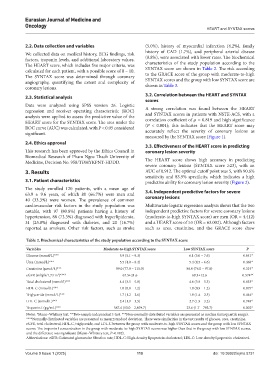
            2.2. Data collection and variables                 (5.0%), history of myocardial infarction (4.2%), family

            We collected data on medical history, ECG findings, risk   history  of  CAD  (1.7%),  and  peripheral  arterial  disease
            factors, troponin levels, and additional laboratory values.   (0.8%), were associated with lower rates. The biochemical
            The HEART score, which includes five major criteria, was   characteristics of the study population according to the
            calculated for each patient, with a possible score of 0 – 10.   SYNTAX score are shown in Table 2. The risk according
            The SYNTAX score was determined through coronary   to the GRACE score of the group with moderate-to-high
            angiography, quantifying the extent and complexity of   SYNTAX scores and the group with low SYNTAX score are
            coronary lesions.                                  shown in Table 3.

            2.3. Statistical analysis                          3.2. Correlation between the HEART and SYNTAX
                                                               scores
            Data were analyzed using SPSS version  26. Logistic
            regression and receiver operating characteristic (ROC)   A  strong  correlation  was  found  between  the  HEART
            analysis were applied to assess the predictive value of the   and SYNTAX scores in patients with NSTE-ACS, with a
            HEART score for the SYNTAX score. The area under the   correlation coefficient of ρ = 0.819 and high significance
            ROC curve (AUC) was calculated, with P < 0.05 considered   (P  < 0.001); this indicates that the HEART score may
            significant.                                       accurately reflect the severity of coronary lesions as
                                                               measured by the SYNTAX score (Figure 1).
            2.4. Ethics approval
                                                               3.3. Effectiveness of the HEART score in predicting
            This research has been approved by the Ethics Council in   coronary lesion severity
            Biomedical Research of Pham Ngoc Thach University of
            Medicine, Decision No. 958/TĐHYKPNT-HDDD.          The HEART score shows high accuracy in predicting
                                                               severe coronary lesions (SYNTAX score ≥23), with an
            3. Results                                         AUC of 0.912. The optimal cutoff point was 5, with 90.6%
                                                               sensitivity and 83.9% specificity, which indicates a high
            3.1. Patient characteristics                       predictive ability for coronary lesion severity (Figure 2).
            The study enrolled 120  patients,  with a mean age of
            63.9  ±  9.6  years, of which 80  (66.7%) were men and   3.4. Independent predictive factors for severe
            40  (33.3%) were women. The prevalence of common   coronary lesions
            cardiovascular risk factors in the study population was   Multivariate logistic regression analysis shows that the two
            notable, with 97  (80.8%) patients having a history of   independent predictive factors for severe coronary lesions
            hypertension, 88 (73.3%) diagnosed with hyperlipidemia,   (moderate-to-high SYNTAX score) are men (OR = 4.412)
            31  (25.8%) diagnosed with diabetes, and 20  (16.7%)   and a HEART score of ≥5 (OR = 63.002). Although factors
            reported as smokers. Other risk factors, such as stroke   such as urea, creatinine, and the GRACE score show

            Table 2. Biochemical characteristics of the study population according to the SYNTAX score

            Variables                        Moderate‑to‑high SYNTAX score     Low SYNTAX score           P
            Glucose (mmol/L)***                     5.9 (5.1 – 9.3)               6.1 (5.0 – 7.6)       0.641*
            Urea (mmol/L)***                        5.5 (4.0 – 8.4)               5.4 (4.5 – 6.6)       0.468*
            Creatinine (µmol/L)***                89.0 (77.0 – 115.0)           86.0 (76.0 – 97.0)      0.315*
            eGFR (ml/ph/1.73 m )****                 67.5±21.6                     69.3±12.6            0.574**
                          2
            Total cholesterol (mmol/l)***           4.4 (3.5 – 5.8)               4.6 (3.9 – 5.3)       0.833*
            HDL-C (mmol/L)***                       1.0 (0.8 – 1.2)               1.0 (0.9 – 1.2)       0.075*
            Triglyceride (mmol/L)***                1.7 (1.2 – 2.6)               1.9 (1.4 – 2.5)       0.444*
            LDL-C (mmol/L)***                       2.4 (1.9 – 3.5)               2.7 (1.9 – 3.2)       0.748*
            Troponin I (pg/mL)***                587.4 (13.0 – 2,859.7)         23.6 (1.7 – 793.7)      0.002*
            Notes: *Mann–Whitney test. **Two-sample independent t-test. ***Non-normally distributed variables are presented as median (interquartile range).
            ****Normally distributed variables are presented as mean±standard deviation. There were similarities in the test results of glucose, urea, creatinine,
            eGFR, total cholesterol, HDL-C, triglyceride, and LDL-C between the group with moderate-to-high SYNTAX scores and the group with low SYNTAX
            scores. The troponin I concentration in the group with moderate-to-high SYNTAX scores was higher than that in the group with low SYNTAX scores,
            and the difference was significant (Mann–Whitney test, P=0.002).
            Abbreviations: eGFR: Estimated glomerular filtration rate; HDL-C: High-density lipoprotein cholesterol; LDL-C: Low-density lipoprotein cholesterol.


            Volume 9 Issue 1 (2025)                        110                              doi: 10.36922/ejmo.5731

