


Page 119 - EJMO-9-1
P. 119
Eurasian Journal of Medicine and
            Oncology
                                                                                         HEART and SYNTAX scores


            Table 3. Risk according to the GRACE score of the group with moderate‑to‑high SYNTAX and low SYNTAX scores
            Variable                    Moderate‑to‑high SYNTAX score (%)  Low SYNTAX score (%)  Total (%)  P
            Low risk (GRACE <109)                 36 (56.3)                 47 (83.9)        83 (69.2)   0.001*
            Moderate-to-high (GRACE ≥109)         28 (43.8)                 9 (16.1)         37 (30.8)
            Total                                 64 (100)                  56 (100)         120 (100)
            Notes: The proportion of patients with moderate-to-high risk according to the GRACE score in the group with moderate-to-high SYNTAX scores was
            43.8%, which is higher than that in the group with low SYNTAX scores (16.1%). The difference in risk according to the GRACE score between the
            group with moderate-to-high SYNTAX scores and the group with low SYNTAX scores was significant (ꭓ  test, P=0.001).
                                                                               2
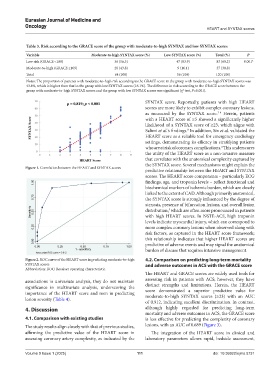
                                                               SYNTAX  score. Reportedly, patients with high  HEART
                                                               scores are more likely to exhibit complex coronary lesions,
                                                                                              7-9
                                                               as measured by the SYNTAX score.  Herein, patients
                                                               with a HEART score of ≥5 showed a significantly higher
                                                               likelihood of a SYNTAX score of ≥23, which aligns with
                                                               Salimi et al.’s findings.  In addition, Six et al. validated the
                                                                                 8
                                                               HEART score as a reliable tool for emergency cardiology
                                                               settings, demonstrating its efficacy in stratifying patients
                                                               who are at risk of coronary complications.  This underscores
                                                                                               4
                                                               the utility of the HEART score as a non-invasive measure
                                                               that correlates with the anatomical complexity captured by
                                                               the SYNTAX score. Several mechanisms might explain the
            Figure 1. Correlation between the HEART and SYNTAX scores
                                                               predictive relationship between the HEART and SYNTAX
                                                               scores. The HEART score components – particularly ECG
                                                               findings, age, and troponin levels – reflect functional and
                                                               biochemical markers of ischemic burden, which are closely
                                                               linked to the extent of CAD. Although primarily anatomical,
                                                               the SYNTAX score is strongly influenced by the degree of
                                                               stenosis, presence of bifurcation lesions, and overall lesion
                                                               distribution,  which are often more pronounced in patients
                                                                         5
                                                               with high HEART scores. In NSTE-ACS, high troponin
                                                               levels indicate myocardial injury, which can correspond to
                                                               more complex coronary lesions when observed along with
                                                               risk factors, as captured in the HEART score framework;
                                                               this relationship indicates that higher HEART scores are
                                                               predictive of adverse events and may signal the anatomical
                                                               burden of disease that requires intensive management.
            Figure 2. ROC curve of the HEART score in predicting moderate-to-high   4.2. Comparison on predicting long-term mortality
            SYNTAX scores                                      and adverse outcomes in ACS with the GRACE score
            Abbreviation: ROC: Receiver operating characteristic.
                                                               The HEART and GRACE scores are widely used tools for
            associations in univariate analysis, they do not maintain   assessing risk in patients with ACS; however, they have
            significance in multivariate analysis, underscoring the   distinct strengths and limitations. Herein, the HEART
            importance of the HEART score and men in predicting   score  demonstrated  a superior  predictive  value  for
                                                               moderate-to-high SYNTAX scores (≥23) with an AUC
            lesion severity (Table 4).
                                                               of 0.912, indicating excellent discrimination. In contrast,
            4. Discussion                                      although highly regarded for predicting long-term
                                                               mortality and adverse outcomes in ACS, the GRACE score
            4.1. Comparison with existing studies              is less effective for predicting the complexity of coronary
            The study results align closely with that of previous studies,   lesions, with an AUC of 0.689 (Figure 3).
            affirming the predictive value of the HEART score in   The integration of the HEART score in clinical and
            assessing coronary artery complexity, as indicated by the   laboratory parameters allows rapid, bedside assessment,


            Volume 9 Issue 1 (2025)                        111                              doi: 10.36922/ejmo.5731

