


Page 225 - EJMO-9-1
P. 225
Eurasian Journal of Medicine and
            Oncology
                                                                            Psoas muscle and atherosclerotic inflammation


            A                      B                           >1.8 (Figure 3B), and TMR values with a threshold >2.3
                                                               (Figure 3C).
                                                                 Figure 4 shows a box-and-whisker plot of the estimated
                                                               TMR values from PET images corresponding to the
                                                               calcium area in CT images. The calcium area was calculated
                                                               as the ratio of calcium to arterial wall circumference and
                                                               clustered into four categories (A1, A2, A3, and A4 in
            C                      D                           ascending order).

                                                                 No significant differences were observed in the
                                                               computed TMR values (TMR, TMR >1.8, and TMR >2.3)
                                                               corresponding to the calcium area clusters A1, A2, and
                                                               A3 (p > 0.05). However, FDG absorption in the ROIs
                                                               corresponding to larger calcium area cluster (A4) was
                                                               found to be statistically higher in terms of TMR values
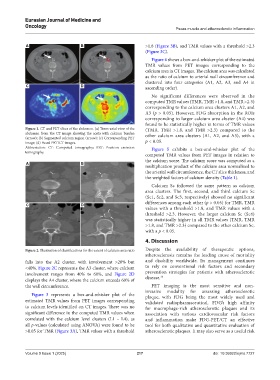
            Figure 1. CT and PET slices of the abdomen. (a) Trans-axial view of the   (TMR, TMR >1.8, and TMR >2.3) compared  to  the
            abdomen from the CT image showing the aorta with calcium burden   other calcium area clusters (A1, A2, and A3), with a
            (arrow); (b) Segmented calcium region (arrow); (c) Corresponding PET
            image; (d) Fused PET/CT images.                    p < 0.05.
            Abbreviation: CT: Computed tomography; PET: Positron emission   Figure  5  exhibits a box-and-whisker plot of the
            tomography.
                                                               computed  TMR  values  from  PET  images  in  relation  to
                                                               the calcium score. The calcium score was computed as a
            A                      B
                                                               multiplication product of the calcium area normalized to
                                                               the arterial wall circumference, the CT slice thickness, and
                                                               the weighted factors of calcium density (Table 1).
                                                                 Calcium Sc followed the same pattern as calcium
                                                               area clusters. The first, second, and third calcium Sc
                                                               (Sc1, Sc2, and Sc3, respectively) showed no significant
                                                               differences among each other (p > 0.05) for TMR, TMR
            C                      D
                                                               values with a threshold >1.8, and TMR values with a
                                                               threshold >2.3. However, the larger calcium Sc (Sc4)
                                                               was statistically higher in all TMR values (TMR, TMR
                                                               >1.8, and TMR >2.3) compared to the other calcium Sc,
                                                               with a p < 0.05.

                                                               4. Discussion

            Figure 2. Illustration of classifications for the extent of calcium area ratio  Despite the availability of therapeutic options,
                                                               atherosclerosis remains the  leading cause of  mortality
            falls  into  the  A2  cluster,  with  involvement  >20%  but   and disability worldwide. Its management continues
            <40%. Figure 2C represents the A3 cluster, where calcium   to rely on conventional risk factors and secondary
            involvement ranges from 40% to 60%, and  Figure  2D   prevention  strategies  for  patients  with  atherosclerotic
                                                                     26
            displays the A4 cluster, where the calcium exceeds 60% of   disease.
            the wall circumference.                              PET imaging is the most sensitive and non-
                                                               invasive modality for assessing atherosclerotic
              Figure  3 represents a box-and-whisker plot of the   plaque, with FDG being the most widely used and
            estimated TMR values from PET images corresponding   validated radiopharmaceutical.  FDG’s high affinity
            to calcium levels identified on CT images. There was no   for macrophage-rich atherosclerotic plaques and its
            significant difference in the computed TMR values when   association with various cardiovascular risk factors
            correlated with the calcium level clusters (L1 – L4), as   and inflammation make FDG-PET/CT an effective
            all p-values (calculated using ANOVA) were found to be   tool for both qualitative and quantitative evaluation of
            >0.05 for TMR (Figure 3A), TMR values with a threshold   atherosclerotic plaques. It may also serve as a useful risk


            Volume 9 Issue 1 (2025)                        217                              doi: 10.36922/ejmo.7727

