


Page 226 - EJMO-9-1
P. 226
Eurasian Journal of Medicine and
            Oncology
                                                                            Psoas muscle and atherosclerotic inflammation


                        A                                     B


                         C


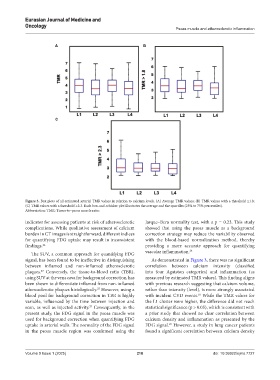
            Figure 3. Box plots of all estimated arterial TMR values in relation to calcium levels. (A) Average TMR values; (B) TMR values with a threshold ≥1.8;
            (C) TMR values with a threshold ≥2.3. Each box-and-whisker plot illustrates the average and the quartiles (25% to 75% percentiles).
            Abbreviation: TMR: Tissue-to-psoas muscle ratio.

            indicator for assessing patients at risk of atherosclerotic   Jarque–Bera normality test, with a p = 0.23. This study
            complications. While qualitative assessment of calcium   showed that using the psoas muscle as a background
            burden in CT images is straightforward, different indices   correction strategy may reduce the variability observed
            for quantifying FDG uptake may result in inconsistent   with the blood-based normalization method, thereby
            findings. 22                                       providing a  more accurate approach  for quantifying

              The SUV, a common approach for quantifying FDG   vascular inflammation. 28
            signal, has been found to be ineffective in distinguishing   As demonstrated in Figure 3, there was no significant
            between inflamed and non-inflamed atherosclerotic   correlation between calcium intensity (classified
            plaques.  Conversely, the tissue-to-blood ratio (TBR),   into  four Agatston categories)  and inflammation  (as
                  27
            using SUV at the vena cava for background correction, has   measured by estimated TMR values). This finding aligns
            been shown to differentiate inflamed from non-inflamed   with previous research suggesting that calcium volume,
            atherosclerotic plaques histologically.  However, using a   rather than intensity (level), is more strongly associated
                                          27
            blood pool for background correction in TBR is highly   with incident CVD events.  While the TMR values for
                                                                                     10
            variable, influenced by the time between injection and   the L1 cluster were higher, the difference did not reach
            scan, as well as injected activity.  Consequently, in the   statistical significance (p > 0.05), which is consistent with
                                       27
            present study, the FDG signal in the psoas muscle was   a prior study that showed no clear correlation between
            used for background correction when quantifying FDG   calcium density and inflammation as presented by the
            uptake in arterial walls. The normality of the FDG signal   FDG signal.  However, a study in lung cancer patients
                                                                         29
            in the  psoas muscle region was confirmed using the   found a significant correlation between calcium density


            Volume 9 Issue 1 (2025)                        218                              doi: 10.36922/ejmo.7727

