


Page 112 - EJMO-9-2
P. 112
Eurasian Journal of
            Medicine and Oncology                                                           UGVAE of breast lesions


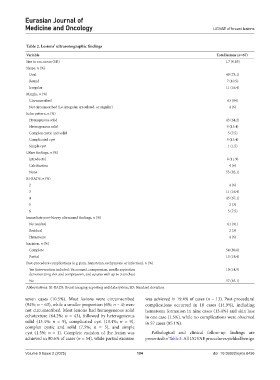
            Table 2. Lesions’ ultrasonographic findings
            Variable                                                                         Total lesions (n=67)
            Size in cm, mean (SD)                                                                1.7 (0.85)
            Shape, n (%)
             Oval                                                                                49 (73.1)
             Round                                                                                7 (10.5)
             Irregular                                                                           11 (16.4)
            Margin, n (%)
             Circumscribed                                                                        63 (94)
             Not circumscribed (i.e. irregular, spiculated, or angular)                           4 (6)
            Echo pattern, n (%)
             Homogenous solid                                                                    43 (64.2)
             Heterogenous solid                                                                   9 (13.4)
             Complex cystic and solid                                                             5 (7.5)
             Complicated cyst                                                                     9 (13.4)
             Simple cyst                                                                          1 (1.5)
            Other findings, n (%)
             Intraductal                                                                          8 (11.9)
             Calcification                                                                        4 (6)
             None                                                                                55 (82.1)
            BI-RADS, n (%)
             2                                                                                    4 (6)
             3                                                                                   11 (16.4)
             4                                                                                   45 (67.1)
             5                                                                                    2 (3)
             6                                                                                    5 (7.5)
            Immediate post-biopsy ultrasound findings, n (%)
             No residual                                                                          61 (91)
             Residual                                                                             2 (3)
             Hematoma                                                                             4 (6)
            Excision, n (%)
             Complete                                                                            54 (80.6)
             Partial                                                                             13 (19.4)
            Post-procedure complications (e.g. pain, hematoma, ecchymosis, or infection), n (%)
             Yes (intervention included: Vacuumed, compression, needle aspiration                10 (14.9)
             demonstrating clot and compression, and sutures with up to 3 stitches)
             No                                                                                  57 (85.1)
            Abbreviations: BI-RADS: Breast imaging-reporting and data system; SD: Standard deviation.

            seven cases (10.5%). Most lesions were circumscribed   was achieved in 19.4% of cases (n = 13). Post-procedural
            (94%; n = 63), while a smaller proportion (6%; n = 4) were   complications occurred in 10  cases (14.9%), including
            not circumscribed. Most lesions had homogeneous solid   hematoma formation in nine cases (13.4%) and skin loss
            echotexture (64.2%;  n = 43), followed by heterogeneous   in one case (1.5%), while no complications were observed
            solid (13.4%;  n = 9), complicated cyst (13.4%;  n = 9),   in 57 cases (85.1%).
            complex cystic and solid (7.5%;  n = 5), and simple
            cyst (1.5%;  n = 1). Complete excision of the lesion was   Pathological and clinical follow-up findings are
            achieved in 80.6% of cases (n = 54), while partial excision   presented in Table 3. All UGVAE procedures yielded benign


            Volume 9 Issue 2 (2025)                        104                              doi: 10.36922/ejmo.8436

