


Page 142 - EJMO-9-2
P. 142
Eurasian Journal of
            Medicine and Oncology                                                     Ovarian cyst differentiation score


            3. Results                                         A                      B

            3.1. Clinical characteristics and CT values
            In the training cohort, a total of 151 patients were enrolled,
            with 68 diagnosed with ovarian endometriotic cysts and
            83 with ovarian cystadenomas. For group comparisons,
            Table  1  revealed significant differences between the two   Figure 2. A representative female case of 44 years old (4 points), with
            groups for the following factors: Age (p < 0.001), clinical   a CA125 value of 82.60  (4 points) and abdominal pain for 2  days.
            symptoms (p = 0.010), CA125 levels (p < 0.001), number   (A) Abdominal CT plain scan shows the left ovary with a cystic tumor
            of cysts (p = 0.006), contour (p < 0.001), LD (p < 0.001),   measuring approximately 4 cm × 5 cm × 5 cm (anteroposterior × transverse
            density heterogeneity (p < 0.001), presence of marginal   × craniocaudal) in size. The CT value is approximately 39 HU in larger
                                                               regions and around 6.9 HU in smaller regions, with a CT value difference
            adhesions (p < 0.001), wall thickness (p < 0.001), and pelvic   of 32.1 HU (2 points). (B) The contrast-enhanced CT scan shows a cystic
            fluid (p < 0.001).                                 lesion with a wall thickness is approximately 4.1 mm (3 points), with a
                                                               blurry margin and evident adhesion to the left adnexa (2 points). The
            3.2. Predictors for the initial model              total score for this case is 15 points, alluding to a diagnosis of ovarian
                                                               endometriotic cysts.
            Univariate analysis revealed that patient age, clinical   Abbreviation: CT: Computed tomography
            symptoms, CA125 levels, cyst number, contour, LD,
            density heterogeneity, marginal adhesions, wall thickness,   A            B
            and pelvic fluid are significant factors in distinguishing
            between ovarian endometriotic cysts and other types
            of cysts. Following a multicollinearity analysis with
            a  tolerance  threshold  >0.1  and  a  variance  inflation
            factor below 5, binary logistic regression identified five
            independent predictive factors: Elevated CA125 levels, age
            within the 21 – 50 years range, mild to moderate density
            heterogeneity, wall thickness of 2  mm or greater, and   Figure  3.  A  representative female case of 37  years old (4 points),
            the presence of marginal adhesions (Table 2). The initial   with  a  pelvic  mass  discovered  for  1  month  and  a CA125  value  of
            model demonstrated an AUC of 0.993  (95%  confidence   26.64 (0 points). (A) Abdominal CT plain scan reveals left ovarian cystic
                                                               enlargement with a cystic mass measuring approximately 5 cm × 7 cm
            interval [CI], 0.985 – 1.000; p < 0.001), indicating excellent   × 4 cm (anteroposterior × transverse × craniocaudal) in size. The cyst
            discriminative ability. With a Youden index of 0.896 and a   in the left adnexal area demonstrates heterogeneous density, with a CT
            cutoff value of 2.0485, the model achieved a sensitivity of   value of approximately 22 HU in larger regions and around 4.3 HU in
            95.6% and a specificity of 94.0%.                  smaller regions, with a CT value difference of 17.7 HU (0 points). (B) The
                                                               contrast-enhanced CT scan shows a cystic lesion with a wall thickness of
            3.3. Establishment of a scoring model              approximately 3.1 mm (3 points), a blurry margin, and adhesion to the
                                                               left adnexa (2 points). The total score for this case is 9 points, alluding to
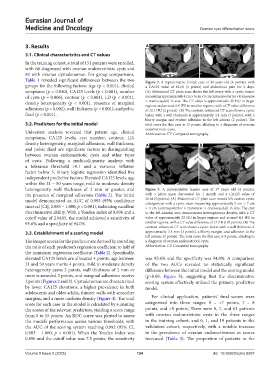
            The integer scores for the predictor are derived by rounding   a diagnosis of ovarian endometriotic cysts.
            the ratio of each predictor’s regression coefficient to half of   Abbreviation: CT: Computed tomography
            the minimum regression coefficient (Table 2). Specifically,
            elevated CA125 levels are allocated 4 points, age between   was 95.6% and the specificity was 94.0%. A comparison
            21 and 50 years merits 4 points, mild to moderate density   of the two AUCs revealed no statistically significant
            heterogeneity earns 2 points, wall thickness of 2 mm or   difference between the initial model and the scoring model
            more is awarded 3 points, and marginal adhesions receive   (p>0.05,  Figure  5),  suggesting that  the discriminative
            2 points (Figures 2 and 3). Cystadenomas are characterized   scoring system effectively utilized the primary predictive
            by lower CA125 elevations, a higher prevalence in both   model.
            adolescents and older adults, thinner walls with smoother
            margins, and a more uniform density (Figure 4). The total   For clinical application, patients’ final scores were
            score for each case in the model is calculated by summing   categorized into three ranges: 0 – <7 points, 7 – 8
            the scores of the relevant predictors, yielding a score range   points, and >8 points, There were 0, 7, and 61 patients
            from 0 to 15 points. An ROC curve was plotted to assess   with ovarian endometriotic cysts in the three ranges
            the model’s performance across various thresholds, with   in the training cohort, and 0, 1, and 19 patients in the
            the AUC of the scoring system reaching 0.992 (95% CI,   validation cohort, respectively,  with a notable increase
            0.983 – 1.000;  p < 0.001). When the Youden index was   in the prevalence of ovarian endometriomas as scores
            0.896 and the cutoff value was 7.5 points, the sensitivity   increased (Table  3). The proportion of patients in the


            Volume 9 Issue 2 (2025)                        134                              doi: 10.36922/ejmo.8507

