


Page 193 - EJMO-9-2
P. 193
Eurasian Journal of
            Medicine and Oncology                                                      Prevalence of PPD in Baghdad


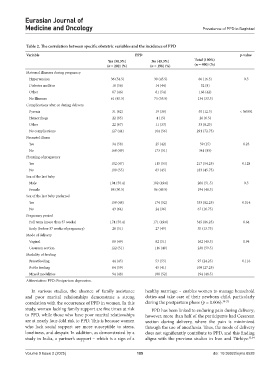
            Table 2. The correlation between specific obstetric variables and the incidence of PPD
            Variable                                      PPD                                          p-value
                                               Yes (50.5%)       No (49.5%)         Total (100%)
                                               (n = 202) (%)     (n = 198) (%)      (n = 400) (%)
            Maternal illnesses during pregnancy
             Hypertension                       36 (54.5)          30 (45.5)         66 (16.5)           0.5
             Diabetes mellitus                   18 (56)           14 (44)            32 (8)
             Other                               87 (46)           81 (54)            168 (42)
             No illnesses                       61 (45.5)          73 (55.5)         134 (33.5)
            Complications after or during delivery
             Pyrexia                             31 (62)           19 (38)           50 (12.5)         < 0.0001
             Hemorrhage                          22 (85)            4 (15)            26 (6.5)
             Other                               22 (67)           11 (33)           33 (8.25)
             No complications                   127 (44)           164 (56)          291 (72.75)
            Neonatal illness
             Yes                                 34 (58)           25 (42)            59 (15)           0.23
             No                                 168 (49)           173 (51)           341 (85)
            Planning of pregnancy
             Yes                                102 (47)           115 (53)          217 (54.25)        0.128
             No                                 100 (55)           83 (45)           183 (45.75)
            Sex of the last baby
             Male                               104 (50.4)        102 (49.6)         206 (51.5)          0.5
             Female                             98 (50.5)          96 (49.5)         194 (48.5)
            Sex of the last baby preferred
             Yes                                159 (48)           174 (52)          333 (82.25)        0.014
             No                                  43 (64)           24 (36)           67 (16.75)
            Pregnancy period
             Full term (more than 37 weeks)     174 (50.4)        171 (49.6)         345 (86.25)        0.64
             Early (before 37 weeks of pregnancy)  28 (51)         27 (49)           55 (13.75)
            Mode of delivery
             Vaginal                             80 (49)           82 (51)           162 (40.5)         0.94
             Cesarean section                   122 (51)           116 (49)          238 (59.5)
            Modality of feeding
             Breastfeeding                       44 (45)           53 (55)           97 (24.25)         0.116
             Bottle feeding                      64 (59)           45 (41)           109 (27.25)
             Mixed modalities                    94 (48)           100 (52)          194 (48.5)
            Abbreviation: PPD: Postpartum depression.
              In  various  studies,  the  absence  of  family  assistance   healthy marriage – enables women to manage household
            and poor  marital  relationships  demonstrate a  strong   duties and take care of their newborn child, particularly
            correlation with the occurrence of PPD in women. In this   during the postpartum phase (p = 0.006). 30-32
            study, women lacking family support are five times at risk   PPD has been linked to enduring pain during delivery;
            to PPD, while those who have poor marital relationships   however, more than half of the participants had Cesarean
            are at nearly four-fold risk to PPD. This is because women   section during delivery, where the pain is minimized
            who lack social support are more susceptible to stress,   through the use of anesthesia. Thus, the mode of delivery
            loneliness, and despair. In addition, as demonstrated by a   does not significantly contribute to PPD, and this finding
            study in India, a partner’s support – which is a sign of a   aligns with the previous studies in Iran and Türkiye. 33,34


            Volume 9 Issue 2 (2025)                        185                              doi: 10.36922/ejmo.8528

