


Page 194 - EJMO-9-2
P. 194
Eurasian Journal of
            Medicine and Oncology                                                      Prevalence of PPD in Baghdad


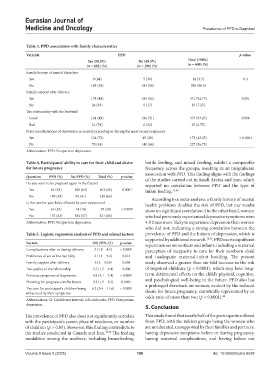
            Table 3. PPD association with family characteristics
            Variable                               PPD                                                 p-value
                                      Yes (50.5%)           No (49.5%)           Total (100%)
                                      (n = 202) (%)        (n = 198) (%)         (n = 400) (%)
            Family history of mental disorders
             Yes                         9 (64)               5 (36)               14 (3.5)              0.3
             No                         193 (50)             193 (50)             386 (96.5)
            Family support after delivery
             Yes                        178 (48)             193 (52)             371 (92.75)           0.001
             No                         24 (83)               5 (17)               29 (7.25)
            The relationship with the husband
             Good                       181 (49)             192 (51)             373 (93.25)           0.006
             Bad                        21 (78)               6 (22)               27 (6.75)
            Prior manifestations of depression or anxiety preceding or during the most recent pregnancy
             Yes                        124 (72)              49 (28)             173 (43.25)          < 0.0001
             No                         78 (34)              149 (66)             227 (56.75)
            Abbreviation: PPD: Postpartum depression.

            Table 4. Participants’ ability to care for their child and desire   bottle feeding, and mixed feeding, exhibit a comparable
            for future pregnancy                               frequency across the groups, resulting in an insignificant
                                                               association with PPD. This finding aligns with the findings
            Question  PPD (%)  No PPD (%)  Total (%)  p-value  of the studies carried out in Saudi Arabia and Iran, which
            Do you want to be pregnant again in the future?    reported no correlation between PPD and the type of
             Yes       62 (38)   100 (62)  162 (40)  0.0001    infant feeding. 37,38
             No       140 (59)   98 (41)   238 (60)              According to a meta-analysis, a family history of mental
            Is the care for your baby affected by your symptoms?  health problems doubles the risk of PPD, but our results
             Yes       65 (82)   14 (18)    79 (20)  < 0.0001  show no significant correlation. On the other hand, women
             No       137 (43)   184 (57)  321 (80)            who had previously experienced depressive symptoms were
            Abbreviation: PPD: Postpartum depression.          4.8 times more likely to experience depression than women
                                                               who did not, indicating a strong correlation between the
            Table 5. Logistic regression analysis of PPD and related factors  prevalence of PPD and the history of depression, which is
                                                               supported by additional research. 38,39 . PPD exerts significant
            Factors                     OR (95% CI)  p-value   repercussions on mothers and infants, including a maternal
            Complications after or during delivery  3 (1.8 – 4.5)  < 0.0001  perception of incapacity to care for their newborn child
            Preference of sex of the last baby  2 (1.1 – 3.4)  0.014  and inadequate maternal-infant bonding. The present
            Family support after delivery  5 (2 – 13.9)  0.001  study observed a greater than six-fold increase in the risk
            The quality of the relationship  3.7 (1.5 – 9.4)  0.006  of impaired childcare (p < 0.0001), which may have long-
            Previous symptoms of depression  4.8 (3.1 – 7.4)  < 0.0001  term detrimental effects on the child’s physical, cognitive,
            Planning for pregnancy in the future   2.3 (1.5 – 3.5)  0.0001  and psychological well-being in the future. PPD also has
                                                               a prolonged drawback on women, evident by the reduced
            The care for participant’s children being   6.2 (3.4 – 11.6)  < 0.0001  desire for future pregnancy, statistically represented by an
            influenced by their symptoms
                                                               odds ratio of more than two (p < 0.0001). 40
            Abbreviations: CI: Confidence interval; OR: odds ratio; PPD: Postpartum
            depression.
                                                               5. Conclusion
            The prevalence of PPD also does not significantly correlate   This study found that nearly half of the participants suffered
            with the participant’s career, place of residence, or number   from PPD, with the riskiest groups being the women who
            of children (p > 0.05). However, this finding contradicts to   are uneducated, unsupported by their families and partners,
            the studies conducted in Canada and Iran. 35,36  The feeding   having depressive symptoms before or during pregnancy,
            modalities among the mothers, including breastfeeding,   having  maternal  complications,  and having  babies  not


            Volume 9 Issue 2 (2025)                        186                              doi: 10.36922/ejmo.8528

