


Page 238 - EJMO-9-2
P. 238
Eurasian Journal of
            Medicine and Oncology                                                Quercetin effects in rats with liver injury


            as  an inhibitor of  NF-κB,  a transcription  factor  that
            regulates the expression of genes involved in inflammatory
            responses. Through this mechanism, quercetin suppresses
            the  production  of  pro-inflammatory  cytokines.
            Furthermore, quercetin downregulates the expression of
            the two inflammatory mediators, cyclooxygenase-2 and
            inducible nitric oxide synthase. These actions contribute
            to the attenuation of hepatic inflammation and confer a
            protective effect against liver injury. 23,24
              Treatment with paracetamol significantly  increased
            the levels of GOT, GPT, TNF-α, NF-κB, and caspase-3
            in the paracetamol-only group, indicating evident liver
            injury and necrosis. A significant rise in MDA levels was
            observed, suggesting that increased lipid peroxidation can
            cause tissue damage. Reduced levels of GSH and BCL2
            were  also  observed  in  this  study. These  findings  aligned
            with previous studies,  which reported elevated serum
                              13
            GOT and GPT levels as urine markers and MDA levels in
            tissue homogenates. 25
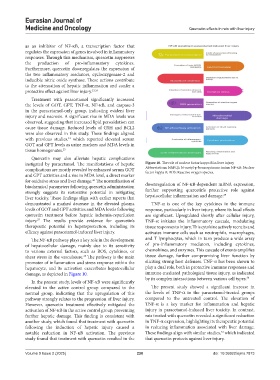
              Quercetin  may  also  alleviate  hepatic  complications
            instigated  by paracetamol. The  manifestations  of  hepatic   Figure 10. The role of nuclear factor kappa B in liver injury
            complications are mostly revealed by enhanced serum GOT   Abbreviations: NAPQI: N-acetyl-p-benzoquinone imine; NF-κB: Nuclear
                                                               factor kappa B; ROS: Reactive oxygen species.
            and GPT activities and a rise in MDA level, a direct marker
            for oxidative stress and liver damage.  The normalization of
                                        26
            biochemical parameters following quercetin administration   downregulation of NF-κB-dependent mRNA expression,
            strongly suggests its restorative potential in mitigating   further supporting quercetin’s protective role against
                                                                                                29
            liver toxicity. These findings align with earlier reports that   hepatocellular inflammation and damage.
            demonstrated  a  marked  decrease  in  the  elevated  plasma   TNF-α is one of the key cytokines in the immune
            levels of GOT and GPT activities and MDA levels following   response, particularly in liver injury, where its local effects
            quercetin treatment before hepatic ischemia-reperfusion   are significant. Upregulated shortly after cellular injury,
            injury.  The results provide evidence for quercetin’s   TNF-α initiates the inflammatory cascade, modulating
                 27
            therapeutic potential in hepatoprotection, including its   tissue responses to injury. This cytokine actively recruits and
            efficacy against paracetamol-induced liver injury.  activates immune cells such as neutrophils, macrophages,
              The NF-κB pathway plays a key role in the development   and T lymphocytes, which in turn produce a wide array
            of hepatocellular damage, mainly due to its  sensitivity   of pro-inflammatory mediators, including cytokines,
            to various external factors, such as ROS, cytokines, or   chemokines, and enzymes. This cascade of events amplifies
            shear stress in the vasculature.  The pathway is the main   tissue damage, further compromising liver function by
                                     28
            promoter of inflammation and stress response within the   eliciting strong host defenses. TNF-α has been shown to
            hepatocyte,  and  its  activation  exacerbates  hepatocellular   play a dual role, both in protective immune responses and
            damage, as depicted in Figure 10.                  immune-mediated pathological tissue injury, as indicated
                                                               by its complex interactions between various cell types. 30
              In the present study, levels of NF-κB were significantly
            elevated in the active control group compared to the   The  present  study  showed  a  significant  increase  in
            normal group, indicating that the upregulation of this   the levels of TNF-α in the paracetamol-treated groups
            pathway strongly relates to the progression of liver injury.   compared to the untreated control. The elevation of
            However, quercetin treatment effectively mitigated the   TNF-α is a key marker for inflammation and hepatic
            activation of NF-κB in the active control group, preventing   injury in paracetamol-induced liver toxicity. In contrast,
            further hepatic damage. This finding is consistent with   rats treated with quercetin revealed a significant reduction
            another study, which found that treatment with quercetin   in TNF-α expression, highlighting its therapeutic potential
            following  the  induction  of  hepatic  injury  caused  a   in reducing inflammation associated with liver damage.
            notable reduction in NF-κB activation. The previous   These findings align with similar studies,  which indicated
                                                                                               31
            study found that treatment with quercetin resulted in the   that quercetin protects against liver injury.

            Volume 9 Issue 2 (2025)                        230                              doi: 10.36922/ejmo.7873

