


Page 70 - EJMO-9-2
P. 70
Eurasian Journal of
            Medicine and Oncology                        Gut microbiota and hyperuricemia: Mechanisms and therapeutic strategies


            subfamily G member 2 (ABCG2), play a substantial role   ecosystem in managing HUA. Further research is essential
            in the pathogenesis of HUA, with approximately 90%   to fully understand the interplay between UA metabolism
            of cases having a genetic component.  Concurrently,   and the gut microbiota and to explore potential therapeutic
                                             1-6
            environmental contributors, including dietary  patterns,   interventions targeting gut microbiota dysbiosis in the
            lifestyle choices, age,  and gender,  significantly influence   context of HUA and its associated disorders.
            HUA development. Many studies have demonstrated
            that diet and dietary components have profound effects   2. The mechanism of gut microbiota
            on the composition of the gut microbiota and are among   affecting purine metabolism
            the most important contributors to alterations in bacterial   The gut microbiota, a complex microbial community
            flora. 7-9
                                                               colonizing the intestines, is crucial for regulating UA
              The modern dietary trend toward increased        metabolism. Dysregulation of the gut microbiota can
            consumption of sugars, fats, and purine-rich foods can   disrupt UA homeostasis, leading to HUA – a condition
            perturb the gut microbiota composition, affecting nutrient   characterized by elevated blood UA levels (Figure 1).
            metabolism, immune regulation, and inflammatory      The adult gut microbiota primarily comprises Firmicutes
            responses, ultimately contributing to metabolic disorders,   (approximately  64%)  and  Bacteroidetes (approximately
            including HUA. The prevalence of HUA varies by region   28%),  with  a  total  abundance  reaching  around  10
                                                                                                            14
            and demographic, with higher rates in European and   microorganisms. Bacteria within the gut microbiota have
            American countries and geographic differences observed   developed adaptive mechanisms for de novo biosynthesis
            within Chinese populations. 10-12                  and purine salvage, influencing UA metabolism. In
              Mounting scientific evidence and clinical data   addition, the gut microbiota can produce substrates that
            underscore a close link between the onset and progression   may enter the liver through the portal vein, leading to
            of HUA and alterations in the intestinal microbiota’s   the  production of  new purine amino acids  and UA. 28-31
            prevalence, distribution, and structural transformations.   Metabolites (cysteine, glutamine, phenylalanine, etc.)
            The gut microbiota is integral to regulating the host’s   were significantly associated with UA change and incident
            metabolic functions and immune system. Dysbiosis,   HUA. Amino acid metabolism appears to play a critical
            or disruption of the microbial equilibrium, can disturb   role. Impairment of intestinal integrity and profound
            multiple physiological metabolic  pathways,  including   alterations in the profile of the solute carrier family resulted
            the UA metabolic cascade. The enzyme xanthine oxidase   in dysregulation of amino acid transportation. 32-35
            (XO), a key player in UA biosynthesis, is expressed in   Recent research suggests  that the  gut  plays  a pivotal
            hepatocytes and exhibits peak expression in the duodenum   role in the pathogenesis of HUA. Intestinal flora actively
            and jejunum. In addition, certain gastrointestinal strains   participates in purine metabolism and UA degradation. UA
            of  Escherichia coli can secrete xanthine dehydrogenase   transporters located in intestinal epithelial cells facilitate
            (XOD), contributing to purine catabolism. 13-23
                                                               the transport of UA from the bloodstream into the intestinal
              The gastrointestinal tract plays a crucial role in   lumen. Key transporters involved in this process include
            maintaining UA homeostasis beyond the kidneys’ primary   ABCG2 and SLC2A9. 36-39  Elevated UA levels can induce
            role in urate excretion. Probiotics within the gut can   inflammation through the toll-like receptors 4/NOD-like
            degrade urate, and the consumption of  Lactobacillus   receptor protein 3 signaling pathway, adversely affecting
            gasseri PA-3 has been associated with reduced serum UA   intestinal epithelial cells. This inflammation leads to
            (SUA) levels and stabilized gut microbiota by decreasing   mitochondrial dysfunction and activation of the NF-κB
            purine absorption. Disruption of the gut microbiota can   signaling pathway, resulting in decreased expression of
            affect the function of urate transporters on intestinal   tight junction proteins and compromised integrity of the
            epithelial cells, influencing UA transport and elimination.   intestinal mucosal barrier. Consequently, the function of
            Distinct differences in the abundance of intestinal flora
            between healthy individuals and those with HUA have
            been observed, with certain species such as  Prevotella,
            Akkermansia, and Barnesiella being linked to HUA. 24-27
              HUA is a complex condition influenced by genetic and
            environmental factors, with diet and lifestyle habits playing
            significant roles. The balance between UA synthesis and
            excretion pathways is influenced by the gut microbiota,
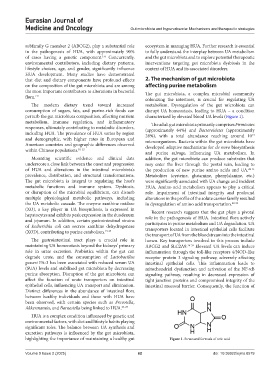
            highlighting the importance of maintaining a healthy gut     Figure 1. Structural formula of uric acid


            Volume 9 Issue 2 (2025)                         62                              doi: 10.36922/ejmo.8579

