


Page 71 - EJMO-9-2
P. 71
Eurasian Journal of
            Medicine and Oncology                        Gut microbiota and hyperuricemia: Mechanisms and therapeutic strategies


            UA transporters in intestinal epithelial cells is impaired,   of intestinal-derived LPS into the bloodstream may
            leading to disorders in intestinal UA excretion. 40,41  increase the risk of gout in geese. 45-48
              The  gut  microbiota  also  participates  in  the  oxidative   Further investigation is required to fully understand
            metabolism of purine. Certain bacteria, such as E. coli and   the complex interplay between the gut microbiota and UA
            Proteus, can secrete XO, a key enzyme in purine oxidation.   metabolism. However, emerging evidence suggests that the
            Studies have demonstrated that gut microbiota is involved   gut microbiota plays a significant role in the pathogenesis
            in the catabolism of purine and UA through the secretion   of HUA. This knowledge opens new avenues for the
            of active enzymes. An imbalance in the gut microbiota   development of targeted therapies for HUA, focusing on
            can lead to an increase in the abundance  of microbiota   modulating the gut microbiota to restore UA homeostasis
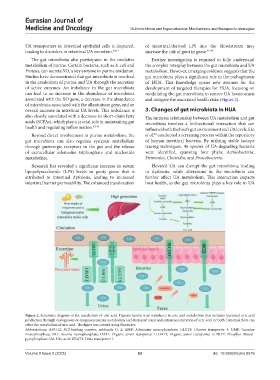
            associated with the XO gene, a decrease in the abundance   and mitigate the associated health risks (Figure 2).
            of microbiota associated with the allantoinase gene, and an
            overall increase in intestinal UA levels. This imbalance is   3. Changes of gut microbiota in HUA
            also closely associated with a decrease in short-chain fatty   The intricate relationship between UA metabolism and gut
            acids (SCFAs), which play a crucial role in maintaining gut   microbiota involves a bidirectional interaction that can
            health and regulating inflammation. 42-44          influence both the host’s gut environment and UA levels. Liu
              Beyond direct involvement in purine metabolism, the   et al.  conducted a screening process within the repository
                                                                   49
            gut microbiota can also regulate systemic metabolism   of human intestinal bacteria. By utilizing stable isotope
            through purinergic receptors in the gut and the release   tracing techniques, 46 species of UA-degrading bacteria
            of extracellular adenosine triphosphate and nucleotide   were identified, spanning four phyla:  Actinobacteria,
            metabolites.                                       Firmicutes, Clostridia, and Proteobacteria.
              Research has revealed a significant increase in serum   Elevated UA can disrupt the gut microbiota, leading
            lipopolysaccharide (LPS) levels in gouty geese that is   to dysbiosis, while alterations in the microbiota can
            attributed to intestinal dysbiosis, leading to increased   further affect  UA metabolism. This  interaction impacts
            intestinal barrier permeability. The enhanced translocation   host health, as the gut microbiota plays a key role in UA


            Figure 2. Schematic diagram of the metabolism of uric acid. Hyperuricemia is an imbalance in uric acid metabolism that includes increased uric acid
            production through endogenous or exogenous purine metabolism and decreased renal and extrarenal excretion of uric acid, or both. Intestinal flora can
            affect the metabolism of uric acid. The figure was created using Biorender.
            Abbreviations: ABCG2: ATP-binding cassette, subfamily G, 2; AMP: Adenosine monophosphate; GLUT9: Glucose transporter 9; GMP: Guanine
            monophosphate; IMP: Inosine monophosphate; OAT1: Organic anion transporter 1; OAT3: Organic anion transporter 3; PRPP: Phosphor-ribosyl-
            pyrophosphate; UA: Uric acid; URAT1: Urate transporter 1.


            Volume 9 Issue 2 (2025)                         63                              doi: 10.36922/ejmo.8579

