


Page 89 - EJMO-9-2
P. 89
Eurasian Journal of Medicine and
            Oncology
                                                                              Cancer pathway ranking through odds ratios


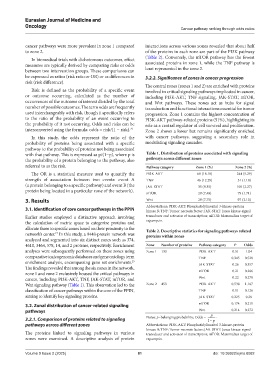
            cancer pathways were more prevalent in zone 1 compared   interactions across various zones revealed that about half
            to zone 2.                                         of the proteins in each zone are part of the PI3K pathway
              In biomedical trials with dichotomous outcomes, effect   (Table 2). Conversely, the mTOR pathway has the fewest
            measures are typically derived by comparing risks or odds   associated proteins in zone 1, while the TNF pathway is
            between two intervention groups. These comparisons can   least represented in the zone 2.
            be expressed as ratios (risk ratio or OR) or as differences in   3.2.2. Significance of zones in cancer progression
            risk (risk difference).
                                                               The central zones (zones 1 and 2) are enriched with proteins
              Risk is defined as the probability of a specific event   involved in critical signaling pathways implicated in cancer,
            or  outcome  occurring,  calculated  as  the  number  of   including PI3K-AKT, TNF signaling, JAK-STAT, mTOR,
            occurrences of the outcome of interest divided by the total   and Wnt pathways. These zones act as hubs for signal
            number of possible outcomes. The term odds are frequently   transduction and functional interactions essential for tumor
            used interchangeably with risk, though it specifically refers   progression. Zone 1 contains the highest concentration of
            to the ratio of the probability of an event occurring to   PI3K-AKT pathway-related proteins (51%), highlighting its
            the probability of it not occurring. Odds and risks can be   role as a central regulator of cell survival and proliferation.
            interconverted using the formula: odds = risk/(1 − risk). 22  Zone 2 shows a lower but remains significantly enriched
              In this study, the odds represent the ratio of the   with  cancer  pathways,  suggesting  a  secondary  role  in
            probability of proteins being associated with a specific   modulating signaling cascades.
            pathway to the probability of proteins not being associated
            with that pathway. This is expressed as p/(1−p), where p is   Table 1. Distribution of proteins associated with signaling
            the probability of a protein belonging to the pathway, also   pathways across different zones
            referred to as the risk.                           Pathway category     Zone 1 (%)       Zone 2 (%)
              The OR is a statistical measure used to quantify the   PI3K-AKT        68 (18.18)       244 (5.29)
            strength of association between two events: event A   TNF                46 (12.29)       51 (1.10)
            (a protein belonging to a specific pathway) and event B (the   JAK-STAT  35 (9.35)        105 (2.27)
            protein being located in a particular zone of the network).  mTOR        28 (7.48)        79 (1.71)
            3. Results                                         Wnt                   29 (7.75)        97 (2.10)
                                                               Abbreviations: PI3K-AKT: Phosphatidylinositol 3-kinase-protein
            3.1. Identification of core cancer pathways in the PPIN  kinase B; TNF: Tumor necrosis factor; JAK-STAT: Janus kinase-signal
            Earlier studies employed a distinctive approach involving   transducer and activator of transcription; mTOR: Mammalian target of
            the calculation of metric space to categorize proteins and   rapamycin.
            allocate them to specific zones based on their proximity to the   Table 2. Descriptive statistics for signaling pathways related
            network’s center.  In this study, a 9448-protein network was   proteins within zones
                         17
            analyzed and segmented into six distinct zones such as 374,
            4610, 3464, 578, 14, and 2 proteins, respectively. Enrichment   Zone  Number of proteins  Pathway category  P  Odds
            analyses were subsequently performed on these zones using   Zone 1  133   PI3K-AKT      0.51  1.04
            comparative toxicogenomic databases and gene ontology term                TNF          0.345  0.528
            enrichment analysis, encompassing gene set enrichments.                   JAK-STAT      0.26  0.357
                                                         23
            The findings revealed that among the six zones in the network,            mTOR          0.21  0.266
            zone 1 and zone 2 exclusively housed the critical pathways in
            cancer, including PI3K-AKT, TNF, JAK-STAT, mTOR, and                      Wnt           0.22  0.278
            Wnt signaling pathway (Table 1). This observation led to the   Zone 2  453  PI3K-AKT   0.538  1.167
            classification of cancer pathways within the core of the PPIN,            TNF           0.11  0.126
            aiming to identify key signaling proteins.                                JAK-STAT     0.225  0.29
            3.2. Zonal distribution of cancer-related signaling                       mTOR         0.174  0.211
            pathways                                                                  Wnt  p       0.214  0.272
            3.2.1. Comparison of proteins related to signaling   Notes: p=belonging probability; Odds =   1−  p  .
            pathways across different zones                    Abbreviations: PI3K-AKT: Phosphatidylinositol 3-kinase-protein
                                                               kinase B; TNF: Tumor necrosis factor; JAK-STAT: Janus kinase-signal
            The proteins linked to signaling pathways in various   transducer and activator of transcription; mTOR: Mammalian target of
            zones were examined. A  descriptive analysis of protein   rapamycin.


            Volume 9 Issue 2 (2025)                         81                              doi: 10.36922/ejmo.8082

