


Page 112 - EJMO-9-3
P. 112
Eurasian Journal of
            Medicine and Oncology                                                        Vitamin D and breast cancer


            in line with the overall analysis results. Moreover, the CIs   revealed no presence of abnormal instrumental variables,
            for each SNP are relatively narrow, suggesting a consistent   further confirming the absence of horizontal pleiotropy;
            contribution of individual SNPs to the research findings.   therefore, the selected 111 instrumental variables can be
            This consistency in SNP contributions adds to the reliability   retained.
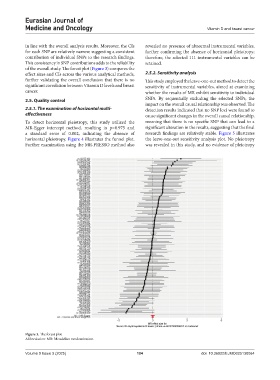
            of the overall study. The forest plot (Figure 3) compares the
            effect sizes and CIs across the various analytical methods,   2.5.2. Sensitivity analysis
            further validating the overall conclusion that there is no   This study employed the leave-one-out method to detect the
            significant correlation between Vitamin D levels and breast   sensitivity of instrumental variables, aimed at examining
            cancer.                                            whether the results of MR exhibit sensitivity to individual

            2.5. Quality control                               SNPs. By sequentially excluding the selected SNPs, the
                                                               impact on the overall causal relationship was observed. The
            2.5.1. The examination of horizontal multi-        detection results indicated that no SNP loci were found to
            effectiveness                                      cause significant changes in the overall causal relationship,
            To detect horizontal pleiotropy, this study utilized the   meaning that there is no specific SNP that can lead to a
            MR-Egger intercept method, resulting in  p=0.975 and   significant alteration in the results, suggesting that the final
            a standard error of 0.002, indicating the absence of   research findings are relatively stable. Figure 5 illustrates
            horizontal pleiotropy. Figure 4 illustrates the funnel plot.   the leave-one-out sensitivity analysis plot. No pleiotropy
            Further examination using the MR-PRESSO method also   was revealed in this study, and no evidence of pleiotropy


            Figure 3. The forest plot
            Abbreviation: MR: Mendelian randomization.


            Volume 9 Issue 3 (2025)                        104                         doi: 10.36922/EJMO025130064

