


Page 135 - EJMO-9-3
P. 135
Eurasian Journal of
            Medicine and Oncology                                                     KRAS TP53 cholangiocarcinoma


            showing a significant overall effect (Z=5.09) and a significant   alterations. 11,16  The  KRAS gene belongs to the RAS gene
            survival difference between the mutant and wild-type groups   family, and through regulation of the RAF-MEK-ERK and
            (p<0.0001). A  subsequent sensitivity analysis (Figure  5)   PI3K-AKT-mTOR signaling pathways, it controls cellular
            showed  that removing  individual  studies  did not  result  in   growth and metabolism. Mutations in KRAS often lead to
            statistically significant differences between studies, suggesting   overactivation of downstream signaling pathways, thereby
            that the results were robust. After addressing publication   promoting tumor cell proliferation.  On the other hand,
                                                                                            17
            bias, Begg’s test and Egger’s test yielded p=0.806 and 0.570,   mutations in TP53 disrupt its ability to bind to its target
            respectively, indicating no publication bias (p>0.05).  DNA sequence, rendering its tumor-suppressive function
                                                               ineffective. 18
            4. Discussion
                                                                 Current studies suggest that cancer patients with
            In the field of genomic research on cholangiocarcinoma,   KRAS or TP53 mutations have poorer survival outcomes
            several  studies  have  reported  that  KRAS  and  TP53   compared to those  without these mutations. 19,20  In a
            mutations are more common compared to other genetic   meta-analysis involving stage II and III colon cancer
                                                               patients, KRAS mutations were found to be associated with
                                                               shortened DFS.  Another meta-analysis on the prognostic
                                                                           21
                                                               role of TP53 mutations in prostate cancer demonstrated
                                                               that patients with TP53 mutations had approximately 13%,
                                                               20%, and 16% lower OS at 1, 3, and 5 years, respectively,
                                                               compared to patients without the mutation.  TP53
                                                               mutations were also associated with increased risk of death
                                                               and accelerated disease progression. 22
                                                                 In   our  study,  the  results  indicated  that
                                                               cholangiocarcinoma patients with  KRAS and  TP53
                                                               mutations had a poorer prognosis compared to those
                                                               without mutations. This meta-analysis summarized
                                                               12 relevant studies, revealing that patients with  KRAS
                                                               mutations had worse prognoses compared to those
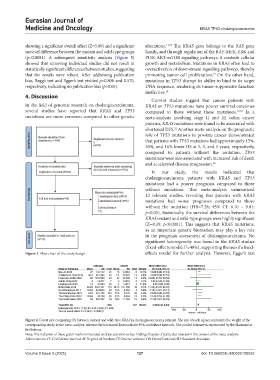
                                                               without the mutation (HR=7.26; 95% CI: 6.10 – 9.81;
                                                               p<0.05). Statistically, the survival differences between the
                                                               KRAS mutant and wild-type groups were highly significant
                                                               (Z=8.39;  p<0.0001).  This  suggests  that  KRAS  mutations,
                                                               as an important genetic biomarker, may play a key role
                                                               in the prognosis assessment of cholangiocarcinoma. No
                                                               significant heterogeneity was found in the KRAS studies
                                                               (fixed-effects model; I =48%), supporting the use of a fixed-
                                                                                2
            Figure 1. Flow chart of the study design           effects model for further analysis. However, Egger’s test


            Figure 2. Forest plot comparing OS between mutant and wild-type KRAS in cholangiocarcinoma patients. The size of each square represents the weight of the
            corresponding study in the meta-analysis, whereas the horizontal lines indicate 95% confidence intervals. The pooled estimate is represented by the diamond at
            the bottom.
            Note: The inclusion of these green marks is intended to draw attention to key findings that are of particular interest in the context of the meta-analysis.
            Abbreviations: CI: Confidence interval; df: Degrees of freedom; IV: Inverse variance; OS: Overall survival; SD: Standard deviation.


            Volume 9 Issue 3 (2025)                        127                         doi: 10.36922/EJMO025120063

