


Page 134 - EJMO-9-3
P. 134
Eurasian Journal of
            Medicine and Oncology                                                     KRAS TP53 cholangiocarcinoma


              All 12 studies reported survival curves that allowed for   wild-type groups (Z=8.39 and p<0.0001). Further, Begg’s
            the examination of the relationship between KRAS and TP53   test indicated no publication bias (p=0.1286), whereas
            mutations and survival outcomes in cholangiocarcinoma.   Egger’s test indicated (p<0.05). Therefore, we performed a
            The survival curves were essential for understanding how   trim-and-fill analysis, and the results are shown in Figure 3.
            these mutations influence patient prognosis. Among the   The trim-and-fill method, a classic adjustment technique
            included studies, five provided 95% CIs necessary for   for publication bias, corrects for the asymmetry in the
            calculating HRs. The remaining studies provided sufficient   effect size distribution using an iterative trimming process.
            data, including survival time and event data, to calculate   This procedure involves two stages: (1) the trimming stage
            HRs and 95% CIs. The specific characteristics of each of the   (trim), where extreme effect size observations (often due to
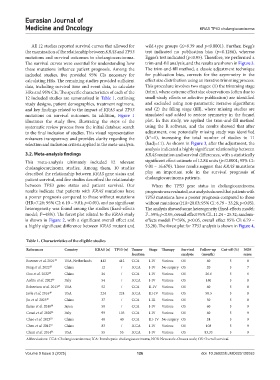
            12 included studies are summarized in Table 1, outlining   small-study effects or selective publication) are identified
            study designs, patient demographics, treatment regimens,   and  excluded  using  non-parametric  iterative  algorithms;
            and key findings related to the impact of KRAS and TP53   and (2) the filling stage (fill), where missing studies are
            mutations on survival outcomes. In addition,  Figure  1   simulated and added to restore symmetry in the funnel
            illustrates the study flow, illustrating the steps of the   plot. In this study, we applied the trim-and-fill method
            systematic review process from the initial database search   using the R software, and the results showed that after
            to the final inclusion of studies. This visual representation   adjustment, one potentially missing study was identified
            enhances transparency and provides clarity regarding the   (k*=1), increasing the total number of studies to 11
            selection and inclusion criteria applied in the meta-analysis.  (kadj=11). As shown in Figure 3, after the adjustment, the
                                                               analysis indicated a highly significant relationship between
            3.2. Meta-analysis findings                        KRAS mutation and survival differences, with a statistically
            This meta-analysis ultimately included 12 relevant   significant effect estimate of 12.84 units (p<0.0001; 95% CI:
            cholangiocarcinoma studies. Among them, 10 studies   9.01 – 16.670). These results suggest that KRAS mutations
            described the relationship between KRAS gene status and   play an important role in the survival prognosis of
            patient survival, and five studies described the relationship   cholangiocarcinoma patients.
            between  TP53 gene status and patient survival. Our   When the  TP53  gene status  in cholangiocarcinoma
            results indicate that patients with  KRAS mutations have   prognosis was evaluated, our analysis showed that patients with
            a poorer prognosis compared to those without mutations   TP53 mutations have a poorer prognosis compared to those
            (HR=7.26; 95% CI: 6.10 – 9.81; p<0.05), and no significant   without mutations (HR=20.03; 95% CI: 6.79 – 33.28; p<0.05).
            heterogeneity was found among the studies (fixed-effects   The analysis showed some heterogeneity (fixed-effects model:
            model; I =48%). The forest plot related to the KRAS study   I =59%; p<0.05, overall effect 95% CI=11.24 – 25.32; random-
                                                               2
                   2
            is shown in Figure 2, with a significant overall effect and   effects model: I =59%, p<0.05, overall effect 95% CI: 6.79 –
                                                                           2
            a highly significant difference between KRAS mutant and   33.28). The forest plot for TP53 analysis is shown in Figure 4,
            Table 1. Characteristics of the eligible studies

            References      Country       KRAS (n)  TP53 (n) Tumor   Stage  Therapy  Survival   Follow‑up   Cut‑off (%)  NOS
                                                         location             analysis  (month)          score
            Boerner et al. 2021 44  USA, Netherlands  412  412  CCA  I-IV  Various  OS   60        5      8
            Peng et al. 2022 25  China      12       /   ICCA   I-IV  No surgery OS      20        5      7
            Guo et al. 2022 45  China       26       /   CCA    I-IV  Various  OS       26.6       5      6
            Ardito et al. 2022 46  Italy    54       /   ICCA   I-IV  Various  OS        180       5      8
            Robertson et al. 2013 47  USA   52       /   CCA    II-IV  Various  OS       60        5      8
            Javle et al. 2016 48  USA       224     224  ICCA   III-IV Various  OS      58.3       5      8
            Jin et al. 2023 49  China       37       /   CCA    I-III  Various  OS       50        5      8
            Ikeno et al. 2018 50  Japan     50       /   CCA    I-IV  Various  OS        60        5      9
            Conci et al. 2020 51  Italy     99      103  CCA    I-IV  Various  OS        60        5      9
            Chao et al. 2023 52  China      40      40   CCA    III- IV No surgery OS    24        5      9
            Chen et al. 2012 53  China      83       /   ICCA   I-IV  Various  OS        108       5      9
            Churi et al. 2014 54  USA       55      55   ICCA   I-IV  Various  OS       83.33      5      9
            Abbreviations: CCA: Cholangiocarcinoma; ICA: Intrahepatic cholangiocarcinoma; NOS: Newcastle–Ottawa scale; OS: Overall survival.


            Volume 9 Issue 3 (2025)                        126                         doi: 10.36922/EJMO025120063

