


Page 136 - EJMO-9-3
P. 136
Eurasian Journal of
            Medicine and Oncology                                                     KRAS TP53 cholangiocarcinoma


            (p<0.05)  suggested  potential  publication  bias,  indicating   showed that excluding individual studies did not lead to
            that some negative or small sample studies may not have   statistically significant differences, indicating that our
            been included in the analysis. Therefore, we applied the   conclusions were robust. Further testing for publication
            trim-and-fill method to correct for publication bias. After   bias using Begg’s test (p=0.806) and Egger’s test (p=0.570)
            the correction, we found that one study was missing from   showed no significant publication bias, further validating
            the original analysis; adding it increased the number of   the reliability of our results.
            studies from 10 to 11, further confirming the significant   In this study, we focused on analyzing the relationship
            relationship between  KRAS mutations and survival   between KRAS mutations, TP53 mutations, and survival
            differences (effect estimate=12.84 units,  p<0.0001). This   prognosis in cholangiocarcinoma patients. Although
            corrected result further strengthened our conclusions.
                                                               mutations in  KRAS or  TP53 alone are associated with
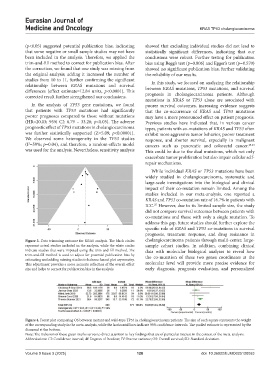
              In the analysis of  TP53 gene mutations, we found   poorer survival outcomes, increasing evidence suggests
            that patients with  TP53 mutations had significantly   that the co-occurrence of  KRAS and  TP53 mutations
            poorer prognoses compared to those without mutations   may have a more pronounced effect on patient prognosis.
            (HR=20.03; 95% CI: 6.79 – 33.28;  p<0.05). The adverse   Previous studies have indicated that, in various cancer
            prognostic effect of TP53 mutations in cholangiocarcinoma   types, patients with co-mutations of KRAS and TP53 often
            was  further  statistically  supported  (Z=5.09;  p<0.00001).   exhibit more aggressive tumor behavior, poorer treatment
            We observed some heterogeneity in the  TP53 studies   response, and shorter survival, especially in malignant
            (I =59%; p=0.04), and therefore, a random-effects model   cancers such as pancreatic and colorectal cancer. 23,24
             2
            was used for the analysis. Nevertheless, sensitivity analysis   This could be due to the dual mutations, which not only
                                                               exacerbate tumor proliferation but also impair cellular self-
                                                               repair mechanisms.

                                                                 While individual KRAS or TP53 mutations have been
                                                               widely studied in cholangiocarcinoma, systematic and
                                                               large-scale investigations into the biological and clinical
                                                               impact of their co-mutation remain limited. Among the
                                                               studies included in our meta-analysis, one reported a
                                                               KRAS and TP53 co-mutation rate of 16.7% in patients with
                                                               ICC.  However, due to its limited sample size, the study
                                                                   25
                                                               did not compare survival outcomes between patients with
                                                               co-mutations and those with only a single mutation. To
                                                               address this gap, future studies should further explore the
                                                               specific role of KRAS and TP53 co-mutations in survival
                                                               prognosis,  treatment  response,  and drug  resistance  in
            Figure 3. Data trimming outcome for KRAS analysis. The black circles   cholangiocarcinoma patients through multi-center, large-
            represent actual studies included in the analysis, while the white circles   sample cohort studies. In addition, combining clinical
            indicate studies that were imputed using the trim-and-fill method. The   data with molecular biological analyses to reveal  how
            trim-and-fill method is used to adjust for potential publication bias by   the co-mutation of these two genes coordinates at the
            estimating and adding missing studies to balance funnel plot asymmetry.
            This adjustment provides a more accurate reflection of the overall effect   molecular  level  will  provide  more  precise  evidence  for
            size and helps to correct for publication bias in the analysis.  early diagnosis, prognosis evaluation, and personalized


            Figure 4. Forest plot comparing OS between mutant and wild-type TP53 in cholangiocarcinoma patients. The size of each square represents the weight
            of the corresponding study in the meta-analysis, while the horizontal lines indicate 95% confidence intervals. The pooled estimate is represented by the
            diamond at the bottom.
            Note: The inclusion of these green marks serves to direct attention to key findings that are of particular interest in the context of the meta-analysis.
            Abbreviations: CI: Confidence interval; df: Degrees of freedom; IV: Inverse variance; OS: Overall survival; SD: Standard deviation.


            Volume 9 Issue 3 (2025)                        128                         doi: 10.36922/EJMO025120063

